
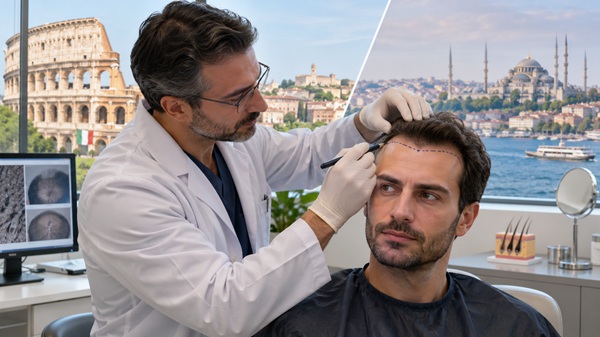
Last editorial review: 23 November 2026. Scope: An evidence-led comparison of elective hair transplantation in Italy and Türkiye for patients considering treatment at home or abroad. Published clinic prices are examples, not national averages, independently verified quotations or proof of clinical quality. This guide does not rank countries by surgical success.
Hair transplant in Italy vs. Turkey: which is the better choice in 2026? For patients living in Milan, Rome or elsewhere in Italy, the decision is rarely as simple as comparing a clinic’s advertised price with a package in Istanbul. Local treatment can make consultations and in-person postoperative reviews easier. Türkiye offers an established international treatment market with bundled travel services, but the real value depends on the named surgeon, the authorised premises, the donor-area plan and support after returning home.
This guide compares published 2026 prices in Italy and Turkey, medical registration, facility authorisation, surgeon involvement, FUE and DHI techniques, realistic long-term outcomes, travel budgets and aftercare. The objective is to help patients ask better questions—not to claim that either country is inherently safer or clinically superior.
Italy vs. Turkey Hair Transplant: Comparison at a Glance
| Decision factor | Italy | Türkiye (Turkey) | What patients should check |
|---|---|---|---|
| Published prices | Italian clinic-published examples vary: Pallaoro lists €3,000–€6,000 for standard hair transplantation; Masullo lists €5,000 for 2,000 follicular units. | Turkish clinic-published examples include Smile Hair Clinic Gold at €2,390 and Cosmedica Sapphire FUE from €2,550; packages differ in scope. | The number of grafts, technique, medical team, inclusions and the final written quotation. |
| Medical registration | Check the individual physician through the FNOMCeO national register and the relevant provincial Order. | Identify the physician and request evidence of qualifications and professional eligibility through appropriate Turkish authorities. | Confirm the actual treating doctor, not only the brand or sales agent. |
| Facility status | Authorisation requirements depend on the premises and relevant regional/ASL framework. | Confirm both the operating facility’s status and any applicable international health tourism authorisation. | Obtain the exact surgical address, not just a consultation or booking office. |
| Surgical responsibility | Needs clinic-specific verification. | Needs clinic-specific verification. | Who diagnoses, designs the hairline, extracts follicles, creates sites and implants grafts? |
| Travel and aftercare | Potentially easier in-person visits for residents near the provider. | Often involves flights, hotel arrangements and remote reviews after returning to Italy. | Who can examine and treat the patient locally if problems arise? |
| Clinical results | There is no standardised national dataset showing that otherwise comparable patients have better long-term outcomes in one of these countries. | Evaluate the physician, individual suitability and documented follow-up. | |
How Much Does a Hair Transplant Cost in Italy vs. Turkey in 2026?
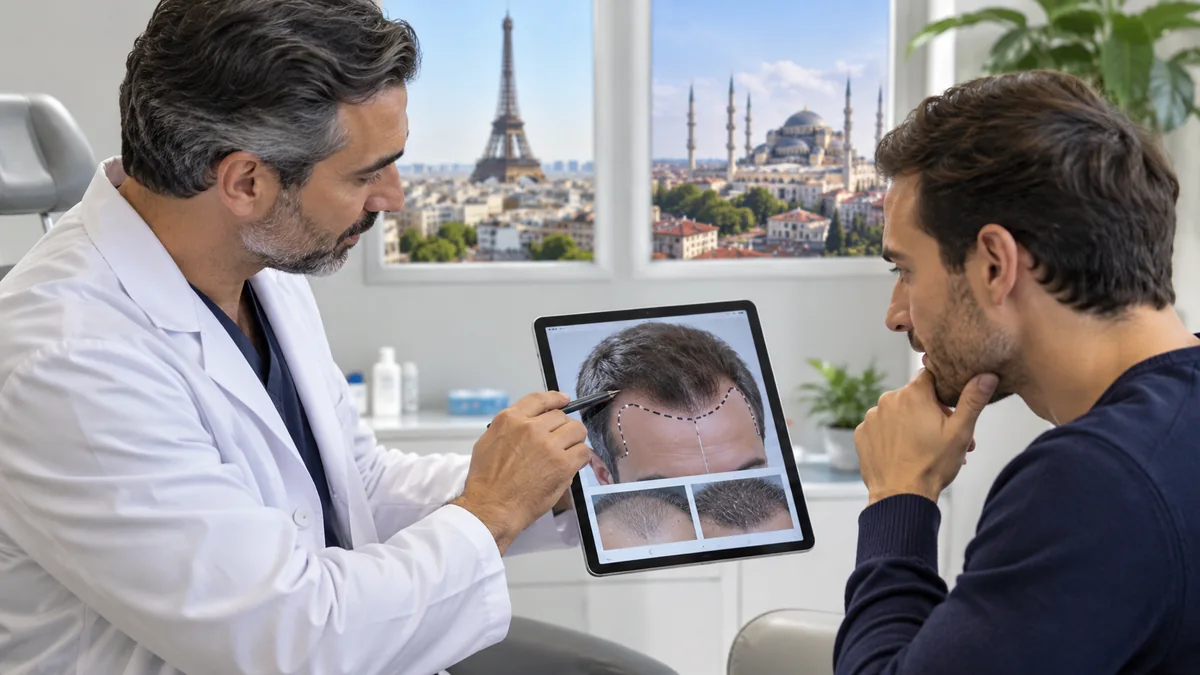
Turkey is often promoted to Italian patients as the cheaper destination. That can be true for particular offers, but a price banner tells only part of the story. A 1,500-graft package cannot be treated as interchangeable with a treatment described as “maximum possible grafts”; similarly, DHI, Sapphire FUE and unshaven options may include different medical and practical services.
Published prices from independent providers in both countries
To avoid using a single clinic as the basis for a country comparison, TurkHairIndex selected publicly accessible tariff pages from two Italian providers and two Istanbul providers. This is a small, illustrative sample, not a representative survey or clinical-quality ranking. Prices, treatment limits and inclusions differ, and none of these offers constitutes a personalised quotation.
| Provider / country | Price published | Treatment scope | Important limitation |
|---|---|---|---|
| Clinica Pallaoro — Italy | €3,000–€6,000 | Standard hair-transplant procedure; separate €6,000–€8,500 band for larger sessions | Indicative range, not a fixed 2,000- or 3,000-graft quotation. |
| Masullo Medical Group — Italy | €5,000 for 2,000 grafts | Per-graft tariff: €2.50 for the first 2,000 and €2.00 for additional grafts; €7,000 published for 3,000 grafts | Published examples require consultation confirmation; check which services apply to your case. |
| Capilclinic — Türkiye | €2,290-€5,200 | Published international package prices vary according to the selected treatment and technique. | Do not assume a matching graft count or identical level of surgeon participation. |
| Cosmedica — Türkiye | FUE Sapphire from €2,550 | Advertised package allowing up to 4,000 grafts subject to treatment planning | “Up to” is a ceiling, not a clinical recommendation to extract that number. |
Source and selection note: The prices above appear on the providers’ own pages and were reviewed for this article in November 2026. The examples are illustrative, not national averages, verified equivalent procedures or endorsements. Ask for a dated, itemised quote and verify the physician, premises and postoperative arrangements separately.
Why there is no single “Italian price” or “Turkish price”
The two Italian examples already illustrate different billing models: a published procedure range and a formula based on follicular units. Turkish providers may sell tiered packages instead. It is therefore misleading to extrapolate a national average from four examples or claim a universal saving. A lower entry fee may not purchase the same graft count, medical services, surgeon involvement or aftercare.
Why a similar-looking fee may still mean a different procedure
Compare the expected number of grafts, donor-area assessment, diagnosis, surgical stages, named physician, anaesthesia, tests, medication, washing appointments, follow-up, taxes, accommodation, travel and revision policy. An apparently all-inclusive price is useful only when the exclusions and responsibilities are clear.
A fixed package price should never determine the number of units extracted. Donor supply is limited; the clinical plan should be based on donor density, the recipient area and future hair loss, rather than a marketing promise of “maximum” or “unlimited” grafts.
The Real Cost: Two Illustrative Italian Patient Budgets
These are constructed budgeting examples, not matched quotations, flight forecasts or nationally representative savings. Travel and incidental costs are hypothetical, and the clinical scopes differ.
Scenario A: A resident of northern Italy comparing an entry-price treatment
Suppose an Italian provider offers an individual treatment at the lower end of Pallaoro’s published standard-procedure band (€3,000). The patient also considers Capilclinic Turkey’s published DHI Advanced package (€3,290). Assume €300 in return flights, €200 in uncovered expenses and €50 for local incidentals. The clinical plans are not known to be equivalent.
| Budget item | Italy illustration | Istanbul illustration |
|---|---|---|
| Advertised procedure or package | €3,000 | €3,290 |
| Assumed return flights | €0 | €300 |
| Assumed incidental expenses | €50 | €200 |
| Illustrative total | €3,050 | €3,790 |
Here, local treatment has the lower hypothetical budget. This is not evidence of clinical equivalence, affordability for every patient or a general price advantage for Italy.
Scenario B: A patient considering approximately 2,000 grafts
Masullo Medical Group publishes €5,000 for 2,000 follicular units. Cosmedica lists a Sapphire FUE package from €2,550 with a maximum advertised allowance of up to 4,000 grafts. The latter limit does not establish what graft count would be appropriate for this patient. Assume €350 for flights, €250 for additional expenses in Turkey and €50 of local costs in Italy.
| Budget item | Italy illustration | Istanbul illustration |
|---|---|---|
| Published treatment or package | €5,000 | €2,550 |
| Assumed return flights | €0 | €350 |
| Assumed incidental expenses | €50 | €250 |
| Illustrative total | €5,050 | €3,150 |
The hypothetical Istanbul budget is lower in this example, but neither published tariff establishes a matched surgical plan, comparable operator involvement or equivalent recovery support. A patient needs two medically justified, itemised proposals before deciding whether the price difference is meaningful.
Patient-specific budgeting formula: treatment + transport + accommodation not covered + tests or medicines excluded + time away from work + anticipated follow-up. The management of complications should be documented in writing, not reduced to an invented standard contingency fee.
Medical Regulations: How to Verify a Hair Transplant Clinic in Italy
Italy has a professional registration system for doctors. Patients can consult the FNOMCeO national register, based on information supplied by provincial medical Orders, to search for a named medical professional. The Italian Ministry of Health explains that medical and other regulated healthcare professions are subject to professional requirements.
Registration confirms a professional fact; it does not establish special expertise in hair restoration, participation in a specific operation or a measured success rate. Ask for the operating surgeon’s full name, professional registration, relevant surgical training and actual responsibilities. If a clinic advertises a team of visiting international physicians, ask who is permitted to practise at the Italian treatment site and who takes medical responsibility.
Who authorises Italian premises?
Healthcare facility regulation involves the Regioni and relevant local health authorities (ASL), with requirements that depend on the facility, service and applicable regional rules. Italy’s Ministry of Health describes the regional organisation of the health system. Rather than assuming that every office offering a consultation is an authorised surgery site, request the legal operator’s identity, the full surgical address, the applicable authorisation and where emergency support is available.
Do not confuse authorisation to operate with accreditation for services reimbursed by the national system. They have different purposes; neither should be presented as a numerical rating of graft survival or patient satisfaction. A website with an Italian office may arrange operations elsewhere, so confirm the actual country and address before paying.
Consent, documentation and professional responsibility
Before scheduling elective surgery, request a written treatment proposal covering diagnosis, expected benefits, alternatives, foreseeable risks, graft planning, limitations and total fees. Find out who will handle postoperative complaints and supply a copy of the clinical record. Marketing promises—such as “perfect results”, “100% growth” or “no risk”—are not substitutes for informed medical consent.
How to Verify a Hair Transplant Clinic in Türkiye
For Turkish clinics treating international patients, the HealthTürkiye provider information and the Turkish Ministry of Health authorisation listings are useful starting points. Check the current status near the expected operation date: entries, names and authorised sites can change.
International health tourism authorisation and the underlying facility’s permission to deliver healthcare answer different regulatory questions. Identify the establishment where graft harvesting and implantation will physically occur, the legal healthcare operator and the individual physician responsible. A local Italian sales representative, translator or travel facilitator is not necessarily the Turkish healthcare establishment.
Do not interpret HealthTürkiye listing, ISO certification, JCI accreditation or positive online reviews as proof of one surgeon’s outcomes. Verify the certificate’s holder and scope, then separately investigate who performs each surgical step.
Five documents or answers to request from an Istanbul provider
- Operating facility: exact address, legal name and applicable current healthcare authorisation evidence.
- Responsible physician: full identity, training and professional status.
- Team responsibilities: who diagnoses, extracts, makes recipient sites and implants the grafts.
- Patient-specific safety plan: donor preservation, anaesthesia, infection prevention and management of complications.
- Aftercare protocol for Italy: surgeon contact, medical notes, remote check-in schedule and the pathway for an urgent in-person examination.
Who Actually Performs the Hair Transplant?
The choice between Italian and Turkish locations matters less clinically than the identity of the treating doctor and the role of the wider team. A clinic may advertise a renowned surgeon, but patients should establish which stages that doctor actually performs or supervises. The ISHRS position statement explains the medical significance of harvesting and recipient-site creation; specific delegation rules depend on the law and appropriately qualified professionals in the relevant country.
Ask who will diagnose the cause of hair loss, calculate donor capacity, design the hairline, administer anaesthesia, perform extraction, create recipient incisions and insert the grafts. Ask to meet the responsible clinician rather than discussing the entire treatment only with a salesperson. It is also reasonable to ask how many procedures the team performs on the same day, although a raw daily case count does not by itself prove or disprove quality.
A meaningful comparison: request written descriptions of these roles from both providers. Terms such as “doctor-led”, “medical supervision” or “exclusive technique” are too vague to establish exactly who is responsible for the operation.
FUE, Sapphire FUE, DHI and FUT: Do Techniques Differ Between Italy and Turkey?
FUE describes individual extraction of follicular units from the donor area, generally creating many tiny extraction marks. FUT removes a donor strip and leaves a different scarring pattern. The most appropriate approach depends on donor characteristics, prior operations, hairstyle and long-term planning.
DHI commonly refers to an implantation workflow using an implanter device; it does not create a separate source of donor hair. Sapphire FUE usually denotes recipient-site blades made with sapphire-tipped material alongside FUE donor harvesting. Branding is not a reliable measure of surgeon experience, graft survival or aesthetic quality. The ISHRS patient resources explain surgical approaches in more detail.
How should patients choose a technique?
Ask the doctor why the technique fits your hair calibre, curl pattern, donor density, scalp characteristics, desired style and likely future loss. Someone considering a corrective transplant, a woman with diffuse thinning or a patient with Afro-textured hair may require a different diagnostic and surgical approach. Neither a country’s reputation nor an advertised instrument should overrule individual clinical judgement.
Hair Transplant Results: Is Italy or Turkey More Successful?
No credible general comparison can assign one national hair-transplant success rate to all Italian clinics and another to all Turkish clinics. Published galleries are selective, patient groups differ, follow-up periods vary and definitions of “success” are not consistent. Reported patient satisfaction is not equivalent to a scientifically measured graft-survival rate.
A responsible surgeon first establishes the cause and stability of the hair loss. Not everyone with thinning is a suitable transplant candidate; a patient with active inflammatory scalp disease, unstable loss or insufficient donor capacity may need a different treatment or a postponed operation.
How to assess before-and-after photographs
Look for cases comparable in hair texture, age, loss pattern, donor density and proposed graft number. Check whether the lighting, camera position and hairstyle are consistent. Demand a clear time interval and find out whether the images show one procedure or several. A photographed result at 9–12 months may demonstrate an individual outcome, but it cannot establish the average performance of the clinic.
Donor preservation is more important than maximum graft numbers
Hair follicles available for transplantation are finite. Excessive extraction can create visible thinning, scarring and reduced options if native hair continues to recede. Request a written estimate of donor resources, intended extraction pattern, planned placement density and remaining reserve. A cheaper price—or a larger graft count—does not compensate for permanent donor damage.
Aftercare: What Happens When an Italian Patient Returns from Istanbul?
Postoperative care is part of the medical treatment. The NHS patient guidance explains that newly placed grafts need particular protection in the first two weeks, temporary shedding is common and full cosmetic results may take approximately 10–18 months. Known potential complications include infection, bleeding, scarring, anaesthetic problems and disappointing growth.
For someone treated near home in Milan, Rome or another Italian city, returning for an examination may be relatively straightforward. A patient operated on in Istanbul may receive an early wash and check before departure, followed by messaging, photographs or video calls in Italy. Remote follow-up can be useful, but it cannot replace urgent physical assessment when symptoms require examination.
Questions to settle before booking a flight back
- Who is the named medical contact during the first 48 hours, first two weeks and following year?
- Which symptoms require an urgent local examination rather than waiting for an online reply?
- Will the clinic provide an operative report, graft count, medication record and clinician details promptly?
- Which clinician in Italy can assess an infection, persistent bleeding or other unexpected symptom?
- If a revision or extra procedure becomes necessary, who decides, and which medical or travel costs are excluded?
Safety note: Seek urgent local medical care for severe, worsening or worrying symptoms. Do not delay treatment because a clinic abroad has not replied. Read any “guarantee” carefully: it may have conditions, exclusions and costs that are not obvious from the advertising.
Does Italy’s National Health Service Cover a Hair Transplant in Turkey?
Patients should not assume reimbursement for an elective hair transplant performed solely for cosmetic reasons in either country. The Italian Servizio Sanitario Nazionale (SSN) covers services under specific eligibility rules; reconstructive or medically necessary circumstances require individual evaluation rather than an automatic promise of coverage.
The Italian Ministry of Health’s national contact-point information addresses cross-border care within the relevant European framework. Türkiye is outside the EU/EEA arrangement associated with the European Health Insurance Card (Tessera Europea di Assicurazione Malattia, TEAM). The TEAM should not be assumed to pay for a planned cosmetic transplant in Istanbul. Ask your ASL and any private insurer directly about the specific proposed procedure and destination.
When Might Italy Be a Better Choice?
Treatment in Italy may suit patients who place particular value on accessible consultations, continuity with a local surgeon, face-to-face reviews and less disruption from international travel. It may also be practical when a patient needs repeated examinations or has a complex medical history. An Italian patient should not, however, select a provider merely because it is nearby if the surgeon’s identity, operating premises or donor strategy cannot be properly explained.
When Might Turkey Be a Better Choice?
Istanbul may be worth considering when a patient identifies a properly authorised operating facility, a physician with relevant documented experience, a medically sound donor plan and a credible arrangement for follow-up in Italy. Bundled accommodation, airport transfers and Italian-speaking assistance can simplify logistics. But a low package price, hotel category or promise of unlimited grafts cannot substitute for verifiable medical responsibility.
How to Compare an Italian Clinic with a Turkish Clinic Before Booking
Ask the same questions of both providers and keep the answers in writing. This helps identify genuine differences in medical care rather than differences in marketing terminology.
| Question | Evidence to request | Why it matters |
|---|---|---|
| Who is the operating surgeon? | Full identity, registration, relevant training and the surgeon’s involvement | Separates the responsible doctor from the clinic brand |
| Where does surgery take place? | Full address, legal operator, applicable facility authorisation | Distinguishes a surgery site from a sales office |
| Who performs each step? | Written allocation of medical and team tasks | Clarifies surgical accountability |
| Why this number of grafts? | Individual donor assessment and recipient-area plan | Preserves finite donor resources |
| What results are documented? | Comparable cases, dates and follow-up duration | Tests relevance rather than headline success claims |
| What happens after surgery? | Named medical contact, emergency pathway, written aftercare | Makes long-distance complication management practical |
| What is the complete price? | Dated itemised quote, exclusions and revision terms | Exposes misleading package comparisons |
Patients investigating Turkish providers may also explore the TurkHairIndex clinic directory and our separate worldwide surgeon selection. These are research resources, not substitutes for independently checking credentials and discussing treatment with a qualified physician.
Italy vs. Turkey: Final Verdict
There is no scientifically defensible winner based on country alone. Italy may offer important convenience for residents seeking local medical continuity. Türkiye offers established international packages and may provide savings in some individual comparisons. Neither advantage is uniform across clinics or patients.
The provider examples in this article show that advertised treatment prices can differ, but those prices do not necessarily cover the same surgical plan, graft number or professional involvement. International travel and aftercare can reduce the apparent gap. The safer basis for a decision is a named and appropriately qualified physician, verifiable operating premises, justified donor strategy, full written budget and reliable postoperative care—wherever the procedure takes place.
Frequently Asked Questions: Hair Transplant Italy vs. Turkey
Is a hair transplant cheaper in Turkey than in Italy?
It can be, but not always after travel and follow-up. Published Italian examples include €3,000–€6,000 at Clinica Pallaoro and €5,000 for 2,000 grafts at Masullo Medical Group; Turkish examples include Capilclinic Standart DHI at €2,290 and Cosmedica FUE Sapphire from €2,550. These are different procedures and package scopes, not directly matched quotations. Compare itemised written proposals.
Can I check whether a hair transplant surgeon is registered in Italy?
Yes. Search the FNOMCeO national register and, when appropriate, the relevant provincial medical Order. Registration does not itself verify a surgeon’s experience or involvement in a particular procedure.
How can I verify a Turkish hair transplant clinic?
Request the exact surgical address and legal healthcare provider, then check the current Turkish Ministry of Health and HealthTürkiye authorisation information. Confirm the identity and responsibilities of the operating physician separately.
Is a hair transplant safer in Italy than in Turkey?
Country alone is not a reliable safety measure. Assess the actual facility, named doctor, permitted team roles, clinical plan, infection prevention and arrangements for complications.
Does a lower package price guarantee equivalent treatment in Turkey?
No. Prices from different clinics can involve different graft limits, clinician roles, facility arrangements and postoperative services. Compare the named surgeon, donor-area plan, surgical stages, consent and follow-up rather than assuming that two advertised packages provide the same care.
Is DHI better than Sapphire FUE?
Neither label guarantees better results. DHI generally describes an implantation method; Sapphire FUE usually refers to recipient-site blade material while graft extraction is still FUE. The suitable choice depends on medical assessment and execution.
How soon can I fly home to Italy after a hair transplant in Istanbul?
Agree travel timing with the operating surgeon. Fresh grafts require protection, and patients should have written instructions and access to urgent medical care during and after the journey.
How long does it take to see full hair transplant results?
Growth develops gradually, and some early shedding is common. NHS guidance says the final result may take approximately 10–18 months, with individual variation.
Will the Italian SSN or TEAM card cover a planned hair transplant in Turkey?
Do not assume reimbursement for an elective cosmetic procedure. Türkiye is outside the EU/EEA TEAM framework. Ask your ASL and any private insurer about your exact circumstances before travelling.
What happens if I need corrective treatment after returning to Italy?
Request your operative records and an in-person medical assessment. Whether revision is appropriate depends on donor reserves, scarring and the cause of the problem. Confirm any contractual revision, travel and aftercare costs in writing.
Should I choose the clinic offering the greatest number of grafts?
No. A larger graft count is not evidence of better quality. The appropriate number depends on hair-loss diagnosis, donor supply, recipient needs and future planning.
Sources and Editorial Method
This comparison uses official professional and government resources for verification and safety, together with public 2026 price pages from two Italian and two Istanbul providers. The examples are not a representative sample, price index, clinical endorsement or comparative outcomes study. Information was reviewed in November 2026 and may change.
- FNOMCeO — Italian national medical register.
- Italian Ministry of Health — regulated health professions.
- Italian Ministry of Health — regional healthcare organisation.
- Italian Ministry of Health — planned cross-border care.
- HealthTürkiye — certified providers.
- Turkish Ministry of Health — international healthcare authorisation listings.
- ISHRS — medical responsibilities in hair restoration surgery.
- NHS — recovery, risks and results timeline.
- Clinica Pallaoro — Italian tariff page; Masullo Medical Group — Italian graft-based prices; Capilclinic Clinic — Istanbul packages; Cosmedica — Istanbul packages.
Editorial disclosure: This comparison is educational, not individual medical advice or an independent clinical audit of named providers. Price examples are a balanced illustration of publicly advertised offerings in both countries; none is included as a recommendation or proof of clinical quality. Verify all relevant professional, regulatory and commercial details before booking.
Leave a Reply