
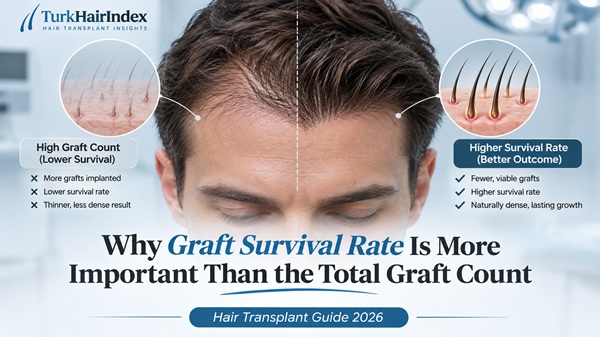
Is a 4,000-graft hair transplant always better than a 3,000-graft procedure? Not necessarily. Graft numbers are easy to advertise, but they do not tell patients how many transplanted follicles will grow, whether the hairline will look natural or how much donor hair will remain available in the future.
A successful transplant depends on more than volume. Extraction damage, graft hydration, handling, storage conditions, recipient-site planning and the patient’s own hair characteristics all contribute to the outcome. Graft survival matters more than a headline graft count when the alternative is extracting additional follicles without achieving a proportional improvement in growth. Yet survival is not the only measure of quality: design, density, safety and long-term planning matter too.
This evidence-informed TurkHairIndex guide explains what graft survival means, how it differs from graft counts and visible density, what the scientific literature actually establishes, and which questions patients should ask before choosing a clinic.
What Is Hair Transplant Graft Survival Rate?
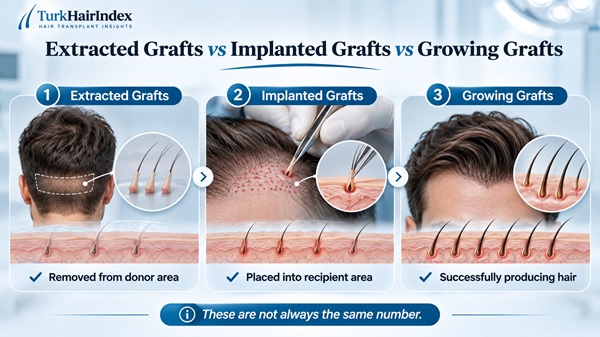
In hair transplantation, a graft usually refers to a follicular unit: a naturally occurring group containing one or several hair follicles, plus surrounding supportive tissue. During a procedure, these units are removed from the donor region and transferred to the recipient area. The surgical graft count records how many units are extracted or implanted; it does not directly measure subsequent growth.
Graft survival rate is a proportion of grafts judged to remain functional and produce hair after surgery, using a defined assessment method and follow-up interval. This sounds straightforward, but there is no single, universally applied measurement protocol in routine clinical practice. Studies may count growing follicular units, individual hairs, or hair density within a small test area. Those measurements are related, not interchangeable.
Grafts, follicles and hairs are not the same thing
- Graft / follicular unit: the unit of tissue transplanted; it may contain more than one hair.
- Follicle: the living anatomical structure capable of producing a hair shaft.
- Hair shaft: the visible strand; it can shed temporarily even when its follicle survives.
- Hair density: the number of visible hairs or follicular units per unit of scalp area, often expressed per square centimetre.
A clinic saying it implanted 3,000 grafts has not necessarily implanted 3,000 individual hairs. Nor does the statement tell us how many of those grafts will be visible at 12 months. Hair calibre, curl and contrast with scalp colour can change the appearance of coverage even at similar graft counts.
Graft Count vs. Survival: A Simple Example
Imagine two hypothetical treatment plans for patients with otherwise comparable donor characteristics, hair quality and areas of hair loss. The figures below are illustrative only; they are not actual results from named clinics, nor typical or guaranteed survival percentages.
| Illustrative measurement | Plan A | Plan B |
|---|---|---|
| Grafts implanted | 4,000 | 3,000 |
| Assumed graft survival | 70% | 95% |
| Grafts producing growth | 2,800 | 2,850 |
In this scenario, the smaller operation produces slightly more growing grafts while extracting 1,000 fewer units from a limited donor supply. The example illustrates why efficient use of grafts can matter more than the largest number on a quotation. It does not imply that either survival percentage is an achievable benchmark for an individual patient.
The arithmetic also leaves out important differences. A well-distributed set of smaller single-hair units can create a soft frontal hairline, while multi-hair units may be valuable farther behind it. Likewise, a transplant that achieves excellent follicular growth could still look unnatural if recipient angles and hairline design are poor.
What Scientific Research Says About Graft Survival
Medical literature identifies several stresses that can damage harvested follicular units. A widely cited review by William M. Parsley examines dehydration, mechanical injury, temperature, storage solutions and time outside the body. Its central practical lesson is to get the fundamentals right before relying on sophisticated additives or marketing claims. Read the full review.
A 2021 study compared follicular units with different types of extraction-related damage, including damage around the bulb and fractures. The researchers observed poorer engraftment for injured grafts than for intact grafts in an experimental model. Crucially, the grafts were implanted into mice; those percentages should not be presented as predicted survival rates for human patients undergoing a full transplant. Read the study.
A further review of optimal graft growth emphasised trauma, tissue oxygenation and biochemical injury. It also cautioned that the survival figures often quoted by clinics can be higher than those consistently achieved in everyday surgery. Read the review.
Why studies cannot be compared by percentage alone
Research may use small test patches rather than full scalp coverage, different storage media, varied surgical methods and follow-up assessments at different times. Some publications measure hair counts rather than the number of surviving follicular units. Even percentages above 100% can appear in hair-count studies because measurement and the number of visible hairs per unit are not identical to graft survival.
For that reason, an advertised “98% survival” figure is meaningful only when the clinic can explain the denominator, measurement method, follow-up period and patient sample. Selected before-and-after photographs are useful illustrations, but they are not a substitute for a systematic clinical outcome study.
Six Factors That Can Affect Graft Growth
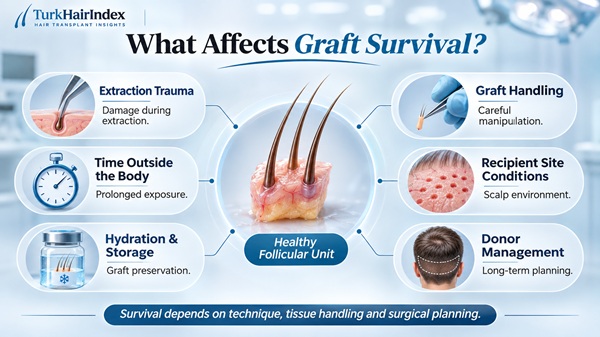
1. Extraction trauma and follicle integrity
With follicular unit excision (FUE), the operator uses a punch to free individual units from their surrounding tissue. A punch that cuts through a follicle may cause transection, while pulling or pressure can damage its bulb, supporting tissue or other structures. The extraction method, punch design, angle, depth and experience of the operator all affect the risk of injury.
Surgeons may inspect harvested units and monitor the proportion showing damage. Patients can ask how the team performs graft quality control and who is responsible for extraction. A claimed low transection rate is more helpful when supported by documented measurements than when used as an unsupported slogan.
2. Dehydration during handling
Follicular units are living tissue and can be harmed if allowed to dry out. The interval between extraction and placement includes several opportunities for desiccation: sorting, counting, transferring and loading grafts into instruments. Keeping grafts suitably hydrated is a basic aspect of good tissue handling. The underlying evidence supports avoiding unnecessary dry exposure, but it does not establish one universal number of safe minutes for every situation.
3. Time outside the body
Once removed, grafts are separated from their normal blood circulation. Longer storage can increase stress, but out-of-body time should never be judged independently of temperature, hydration and preservation medium. The literature contains experiments in which short and somewhat longer holding periods produced results that did not change in a simple linear pattern.
Some clinics deliberately implant in smaller batches to shorten the time between extraction and insertion. That may be a sensible procedural choice, but a branded “minimum time” protocol cannot be assumed to outperform every other protocol without robust comparative clinical data.
4. Storage solution and temperature
Clinical teams use appropriate holding solutions and temperature-management methods to protect extracted tissue. The concentration of salts, pH and other characteristics of the storage solution may affect the cells. Cooling can slow metabolic activity, but inappropriate cold exposure can cause problems of its own.
Specific proprietary storage solutions are sometimes promoted as evidence of exceptional growth. Patients should separate plausible laboratory benefits from proven improvement in long-term human transplant outcomes. A sound procedure starts with careful handling, hydration and suitable storage conditions rather than any single additive.
5. Implantation trauma and recipient-site planning
Grafts can be injured after extraction if they are squeezed, bent or repeatedly manipulated. Recipient incisions must also be planned for the grafts and the tissue receiving them. Excessive pressure, inappropriate depth or poor angulation can affect healing and appearance.
Dense packing is not automatically better. Recipient-site spacing should balance desired coverage, local tissue conditions, hair characteristics and the available blood supply. A natural hairline requires attention to angle, direction and the use of appropriate follicular units, not simply greater density.
6. Patient and scalp characteristics
Scarring, previous procedures, inflammatory scalp conditions and general health factors may influence healing or available donor resources. The patient’s hair calibre, curl, colour contrast and pattern of progressive hair loss affect how successful the result appears. These variables are among the reasons that one clinic’s published outcome cannot be promised to another patient.
Does FUE, DHI or Sapphire FUE Produce Higher Survival?
The terminology used in hair transplant marketing often mixes two different stages: harvesting follicular units from the donor area and implanting them into the recipient area.
| Term | What it mainly describes | Does it prove better survival? |
|---|---|---|
| FUE | Individual graft extraction | No universal guarantee |
| Manual vs. motorised FUE | How the punch is operated | Depends on execution and patient |
| DHI | Often implanter-assisted graft placement | The label alone does not prove it |
| Sapphire FUE | FUE with sapphire-tipped recipient-site blades | Blade material alone does not prove it |
| Stick and Place | Sequence of recipient-site creation and graft placement | Requires comparable outcome evidence |
For example, a patient might undergo FUE harvesting followed by implanter-assisted placement. Calling this “DHI” does not change the fact that extraction still matters. Likewise, a sapphire blade describes the recipient-site tool rather than an alternative donor-extraction technique.
When a clinic promotes one method, ask exactly how it differs from the proposed alternative and which published, patient-relevant outcomes support the claim. The central issue is the whole surgical pathway—not a technology label.
Why Donor Preservation Is Part of the Survival Equation
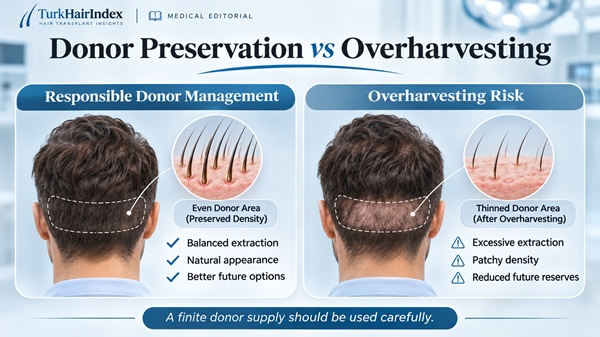
The donor area is a limited resource. Follicular units removed from the back and sides of the scalp are not normally replaced by newly generated follicles in those extraction sites. If a clinic extracts more grafts than necessary, the donor region may become visibly thinned and future surgery may be more difficult.
This is particularly important for younger patients or those with an advancing pattern of androgenetic hair loss. A pleasing hairline today must be planned alongside the possibility of further thinning in the mid-scalp or crown. Using grafts effectively means considering the number needed, the number likely to grow and the reserve remaining after treatment.
The right plan is not necessarily a smaller operation. Some patients genuinely need extensive restoration. The point is that every additional graft should have a medically and aesthetically reasoned purpose.
How Can a Clinic Measure Graft Survival?
At the end of an operation, a clinic can document the number of extracted and implanted grafts. Measuring eventual growth is harder. Hair cycles mean some shafts shed shortly after transplantation before new hair emerges. Without a defined baseline and repeat assessment, visible progress cannot be converted into a reliable survival percentage.
Clinical studies may use marked recipient-area squares, standardised macrophotography or trichoscopic hair counts. A rigorous description should specify what was counted (follicular units or hairs), when it was counted, the measurement area and how missing follow-up data were handled.
A practical timeline for patients
- First weeks: healing and possible shedding of transplanted hair shafts; shedding does not necessarily mean graft death.
- Months 3–4: early new growth may become visible, with wide individual variation.
- Months 6–9: coverage and hair calibre often continue developing.
- Months 12–18: many results approach maturity, although some areas or individuals may evolve for longer.
These are broad recovery milestones, not guarantees or substitutes for individual medical follow-up. A patient can have successful graft growth while continuing to lose non-transplanted native hair; the two processes should be assessed separately.
How to Evaluate a Clinic’s “95–98% Survival” Claim
High survival claims should prompt questions rather than automatic confidence or dismissal. Ask whether the percentage comes from a peer-reviewed clinical study, a clinic’s consecutive-patient audit, a small controlled test area or an estimate based on photographs. Ask whether the figure is for all eligible patients or only selected cases.
It is also worth asking if the clinic has documented the same metric consistently over time, and whether its surgeons, facilities and methods match the published population. A strong testimonial can describe one person’s experience; it cannot establish the average biological success of an entire service.
Seven Questions to Ask Before Booking
- How was my graft estimate calculated? Ask about recipient area, current hair density, hair characteristics and the likely progression of loss.
- Who performs each surgical stage? Identify the doctor responsible for examination, hairline design, extraction, recipient sites and implantation.
- How are grafts examined for damage? Find out whether the team checks follicular integrity and records extraction-related injury.
- How are grafts stored and hydrated? Ask about handling, holding solutions, temperature and time outside the body.
- How do you protect my donor area? Request an explanation of remaining donor density and planning for future sessions.
- How do you measure growth or survival? Request the definition, method, follow-up interval and source of any advertised percentage.
- What follow-up and complication support is available? Especially for international travel, clarify who will assess concerns after returning home.
Frequently Asked Questions About Graft Survival
Is graft survival more important than graft count?
It is more meaningful than graft count alone because a follicular unit must grow to contribute to the result. However, natural design, hair calibre, placement and preservation of the donor area are also essential.
What is a good hair transplant survival rate?
There is no single guaranteed rate for every patient. Published estimates vary with study methods, follow-up and clinical circumstances. Clinics quoting a percentage should explain how it was obtained.
Are 4,000 grafts always better than 3,000?
No. The result depends on growing follicles, the number of hairs per unit, area covered, hair characteristics, distribution and long-term planning. More grafts can be justified in some cases but are not inherently better.
Does reducing out-of-body time guarantee better survival?
No. Avoiding unnecessarily prolonged exposure is sensible, but temperature, hydration, storage solution and trauma also influence viability. Shorter time alone does not prove a superior result.
Is DHI better than FUE for graft survival?
DHI commonly refers to an implantation technique, while FUE refers to graft harvesting. They are not directly equivalent alternatives, and neither label alone establishes a higher survival rate.
Can transplanted hairs shed even if grafts survive?
Yes. Temporary shedding of the visible hair shafts is common after transplantation. New growth may emerge over subsequent months, so early shedding does not necessarily indicate failure.
When can graft survival be assessed reliably?
Meaningful evaluation takes months and depends on the measurement method. Many patients are assessed around 12 months, with some results continuing to mature afterwards. Photographs alone cannot provide an exact graft-survival percentage.
Conclusion: Judge the Result, Not Just the Number
A quoted graft count is useful for understanding the planned scale and cost of treatment. It is not a complete measure of quality. A well-planned hair transplant should protect follicles throughout extraction, handling and implantation, use the donor supply responsibly and produce coverage suited to the patient’s long-term pattern of hair loss.
Graft survival is a more meaningful goal than simply maximising the number of harvested units—but it should be evaluated alongside medical safety, hairline design, recipient distribution, donor preservation and documented follow-up.
TurkHairIndex encourages patients to compare evidence, medical responsibilities and the complete surgical protocol rather than relying on isolated figures or guaranteed percentages. Explore our hair transplant clinic assessments for a broader evidence-based framework.
Scientific References
- Parsley WM. Review of Factors Affecting the Growth and Survival of Follicular Grafts. Journal of Cutaneous and Aesthetic Surgery. 2010. Full text.
- Kwack MH, et al. Comparative Graft Survival Study of Follicular Unit Excision Grafts With or Without Minor Injury. Dermatologic Surgery. 2021. PubMed. Experimental model; not a direct estimate for routine human procedures.
- Optimal Graft Growth. 2013. PubMed.
- Follicular Unit Extraction (FUE) Hair Transplant: Curves Ahead. Full text.
- Complications in Follicular Unit Excision Hair Transplantation: Current Evidence and Practical Approaches. Frontiers in Medicine. 2026. Full text.
Leave a Reply