
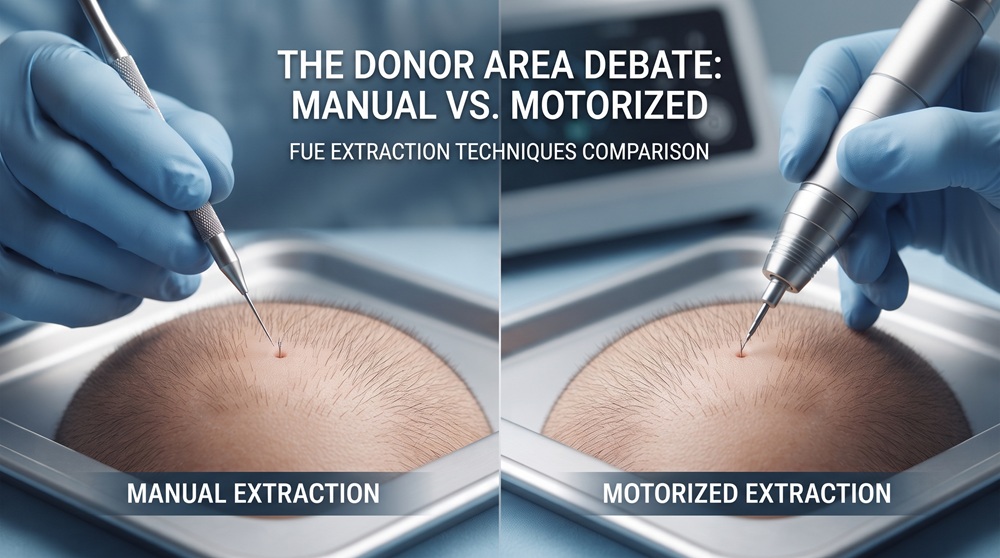
Why the most important FUE decision may not be the one patients can see
In hair transplantation, technology is easy to market. Donor preservation is harder to demonstrate.
A motorized handpiece can look more advanced than a manually operated punch. A manual instrument can suggest greater precision and craftsmanship. Both impressions may influence a patient’s perception of surgical quality, yet neither tells the whole story of what happens beneath the scalp.
The real question is not whether a motor is better than a surgeon’s hand. It is whether the chosen extraction method can remove the right follicular units with minimal unnecessary tissue damage, maintain a natural-looking donor area and preserve options for the future.
That distinction matters because the donor area is not an unlimited supply of hair. Every follicular unit extracted during follicular unit excision (FUE) is a unit no longer available in its original position. If extraction is poorly planned or excessively concentrated, the consequences may extend beyond the immediate procedure, affecting the appearance of the back and sides of the head and potentially limiting future surgical options.
The debate between manual punch and motorized extraction, therefore, deserves a more meaningful framework than old-versus-new technology. It is a debate about surgical control, biological variability, operator skill and the long-term management of a finite resource.
1. Manual and motorized FUE: what actually changes?
Both methods use a small cylindrical punch to separate follicular units from the donor scalp. The main difference is how the instrument is driven during the incision stage.
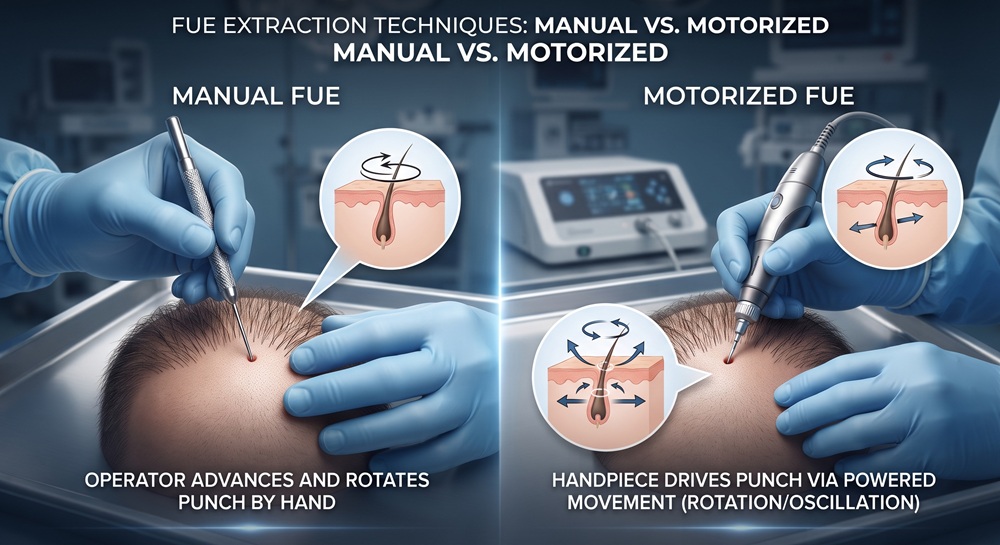
With manual FUE, the operator advances and rotates the punch by hand. With motorized FUE, a handpiece drives the punch using a powered movement, which may involve rotation, oscillation or a combination of motions, depending on the device.
The distinction is technical, but its implications are practical.
A manual punch may provide the operator with direct tactile feedback and precise control over individual movements. A motorized system can make repetitive movements more consistent, reduce physical fatigue and improve efficiency during lengthy extraction sessions.
However, neither approach eliminates the need to judge follicular direction, depth, tissue resistance and the behaviour of individual grafts. Nor does either system independently determine how many grafts should be removed, where extraction should occur or how much donor density should remain.
These are separate decisions that depend on the patient, the surgical plan and the experience of the person performing the procedure.
Professional guidance on hair transplantation recognises both manual and powered punch systems. It emphasises appropriate instrument selection, reducing follicular transection and avoiding excessive harvesting rather than establishing one universal winner. [1]
The first principle of the donor area debate is consequently straightforward: the extraction mechanism is a variable in surgical quality, not a substitute for it.
2. The case for manual extraction: control at the point of incision
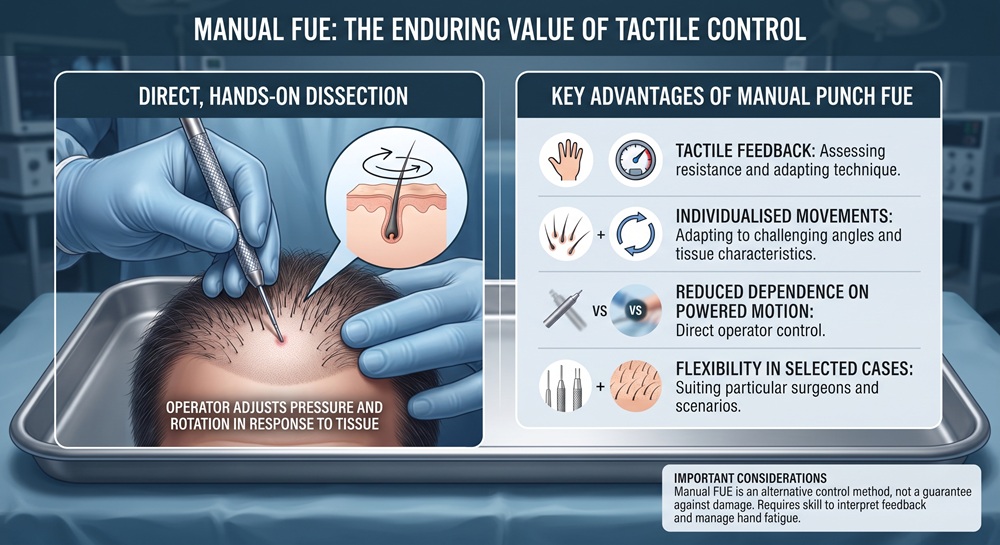
Manual extraction has an enduring place in FUE because it offers a direct, hands-on approach to follicular dissection.
The operator controls the movement of the punch and can adjust the applied pressure and rotation in response to the tissue being encountered. This may be particularly useful when working around challenging follicular angles, irregular tissue characteristics or previously operated donor areas.
The value of manual extraction is not that human hands are inherently more accurate than machines. It is that a skilled operator may prefer the feedback and movement characteristics of a particular manual instrument for a specific anatomical situation.
Potential advantages of manual punch FUE
- Tactile feedback: The operator can assess resistance during punch advancement and adapt technique accordingly.
- Individualised movements: Each incision can be approached according to the angle and characteristics of the selected follicular unit.
- Reduced dependence on powered motion: The operator determines the punch movement directly rather than relying on a motorised mechanism.
- Flexibility in selected cases: Manual instruments may suit particular surgeons, punch designs and donor characteristics.
These advantages should not be confused with guaranteed clinical outcomes.
Manual extraction can still damage follicles if the punch is poorly aligned, advances too deeply or fails to account for the direction of the follicle beneath the skin. Hand fatigue and repetitive movements may also become relevant during prolonged procedures.
Furthermore, tactile feedback is useful only when the operator knows how to interpret it. Feeling resistance does not necessarily reveal exactly where every follicle lies.
Manual FUE is therefore best understood as an alternative method of instrument control, not an automatic safeguard against graft damage or donor depletion.
3. The case for motorized extraction: efficiency without abandoning precision
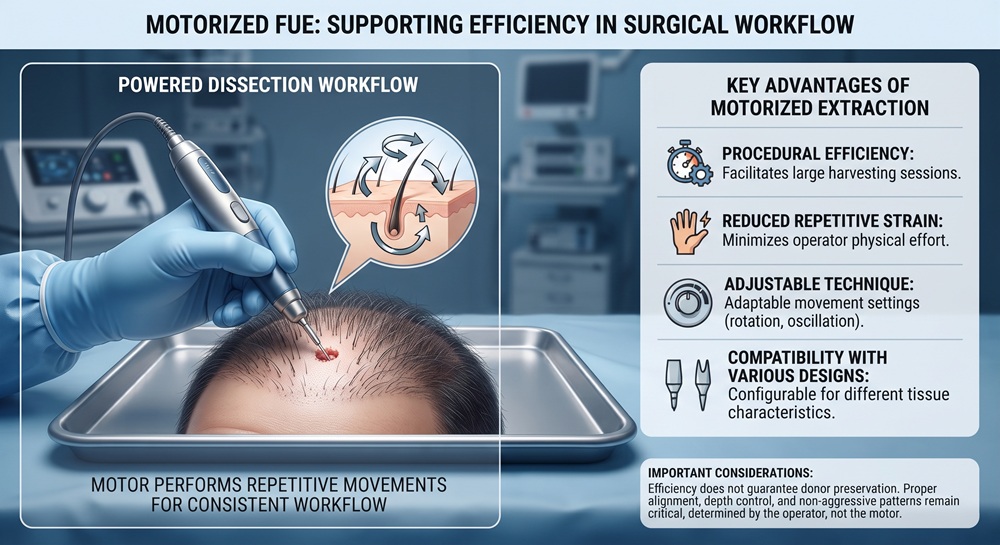
Motorized FUE has become an important part of modern hair-transplant practice because powered systems can make repetitive extraction more efficient.
Depending on the handpiece, punch design and operating settings, a motorised system may use continuous rotation, oscillating motion or other controlled movements. These differences matter: motorized extraction is not one standardised technique, and devices should not be treated as interchangeable.
The main operational advantage is that the motor supplies the movement required for repeated incisions. This can reduce the physical effort involved in harvesting large numbers of follicular units and may help the operator maintain a more consistent workflow.
Potential advantages of motorized extraction
- Procedural efficiency: Powered movement can facilitate repetitive incision-making during larger harvesting sessions.
- Reduced repetitive strain: The motor performs the rotational or oscillatory movement, reducing some of the physical effort required from the operator.
- Adjustable technique: Depending on the device, the operator may be able to adapt movement settings to the requirements of the procedure.
- Compatibility with different punch designs: Modern systems offer a range of configurations intended to address different follicular and tissue characteristics.
But efficiency introduces a distinction that patients should understand: completing more extractions in less time does not necessarily mean preserving the donor area more effectively.
A powered punch still has to be aligned with the follicular unit. Depth still matters. The characteristics of the scalp still matter. And if the extraction pattern is too aggressive, the use of advanced equipment will not prevent donor depletion.
A motor can standardise movement, but it cannot independently determine whether a graft should be harvested in the first place.
The strongest argument for motorized extraction is therefore not that it is inherently superior. It is that it can support an efficient, controlled surgical workflow when the operator selects and uses the system appropriately.
4. The hidden variable: follicular transection
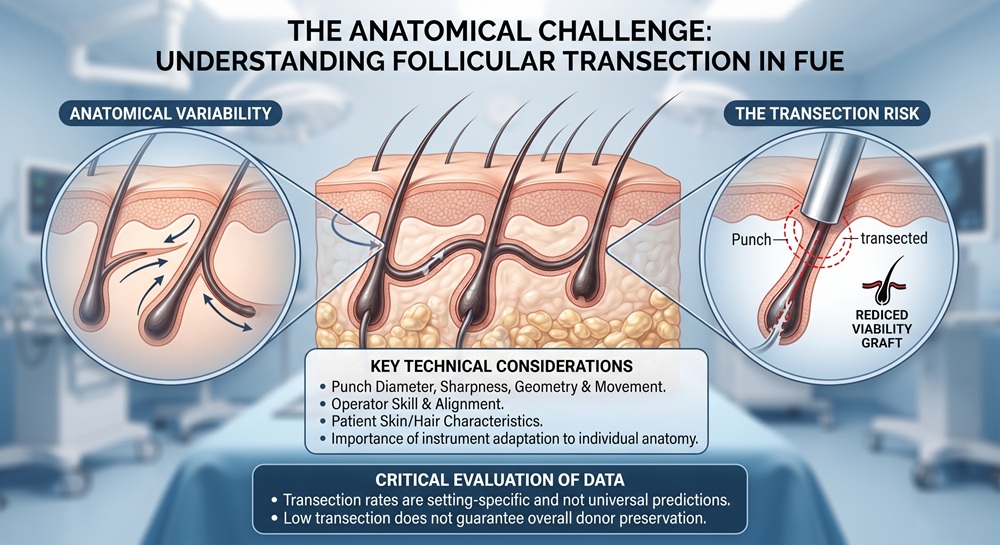
One of the most important technical considerations in FUE is follicular transection.
Transection occurs when a follicle or part of its structure is cut or damaged during the extraction process. A transected graft may have reduced viability or fail to produce the expected growth, depending on the extent and location of the injury.
The challenge is anatomical. Follicular units do not necessarily travel straight down from the point where the hair emerges through the skin. Individual follicles can curve, change direction or diverge within the same unit. The operator must therefore make an incision around a three-dimensional structure that cannot be fully seen from the surface.
Punch diameter, sharpness, geometry, movement, alignment and depth can all influence the procedure. The characteristics of the patient’s skin and hair introduce further variability.
This explains why a comparison based solely on manual versus motorized operation is incomplete.
A 2020 review of FUE instrumentation described developments in punch shapes and powered devices designed to reduce follicular transection, while emphasising the need to adapt instruments to individual hair and skin characteristics. [2]
A 2024 comparative study examined rotary and oscillatory punch methods in 15 patients. It reported graft-yield rates of 88.3% and 90.5%, respectively, with a statistically significant difference between the groups. The average number of follicles per graft did not differ significantly. [3]
These findings illustrate why the details of the instrument’s movement may matter. However, the study was small and compared two powered punch movements, not manual extraction against motorized extraction. Its results cannot establish that one broad extraction category is superior to the other.
This distinction is essential when evaluating clinic claims, published statistics or equipment marketing.
A transection rate is meaningful only when the measurement method, the type of instrument, the operator, the patient population and the conditions of the comparison are understood. A figure taken from one setting should not be presented as a universal prediction of another patient’s outcome.
More importantly, a low transection rate does not, by itself, prove that the donor area has been preserved well.
5. Donor preservation: the metric that deserves more attention
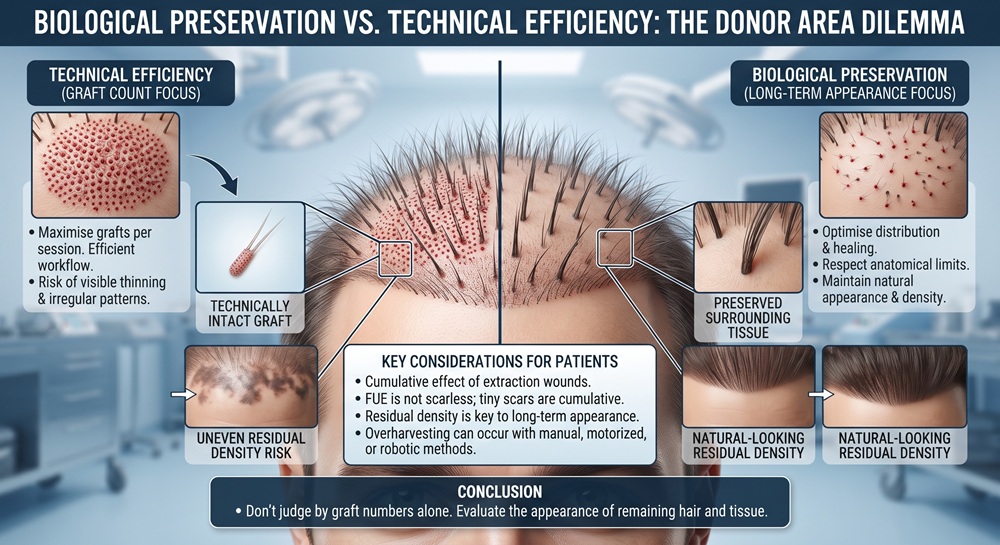
The donor area is often discussed in terms of graft numbers. How many grafts can be extracted? How many can be transplanted in one session? How much coverage can be achieved?
These questions are relevant, but they are not sufficient.
A donor area must be evaluated in terms of both the follicular units removed and the characteristics of the tissue and hair that remain. Two patients receiving the same number of extractions may experience very different visible changes because their original density, hair calibre, follicular-unit composition, scalp characteristics and extraction patterns differ.
This is where the distinction between technical efficiency and biological preservation becomes critical.
Overharvesting is not exclusive to either method
Overharvesting occurs when too many follicular units are removed, or when extraction is distributed in a way that leaves visible thinning, irregular density or an unnatural appearance in the donor area.
It can occur with manual, motorized or robotic extraction. The determining factors include the quality of donor assessment, the extraction plan, the distribution of harvesting and the discipline to remain within an appropriate surgical limit. [4]
A donor area can be compromised even if individual grafts are extracted successfully.
For example, a technically intact graft may still have been removed from a location where its extraction contributes unnecessarily to visible thinning. Similarly, an operator may achieve an efficient harvesting session while creating an uneven pattern of residual density.
The opposite is also possible: a carefully planned procedure can remove an appropriate number of grafts while maintaining a more uniform appearance, regardless of whether the punch is operated manually or by a motor.
The cumulative effect of extraction
Each extraction creates a small wound. The overall donor appearance depends on the cumulative effect of these wounds, the amount and distribution of tissue removed, the healing response and the density that remains between extraction sites.
This is why the concept of a scarless FUE procedure is misleading. FUE generally avoids the continuous linear scar associated with strip harvesting, but individual extraction sites can leave small scars or areas of reduced pigmentation. Their visibility varies between patients and can become more noticeable with very short hairstyles.
The relevant goal is not to promise an invisible donor area under every condition. It is to minimise unnecessary injury and preserve a natural appearance within the limitations of the patient’s anatomy and healing response.
For the patient, this also means that a donor area should not be judged only by how it looks immediately after the procedure. Healing, hair length and the distribution of residual hair influence the eventual appearance.
6. Why punch diameter, depth and distribution matter as much as the motor
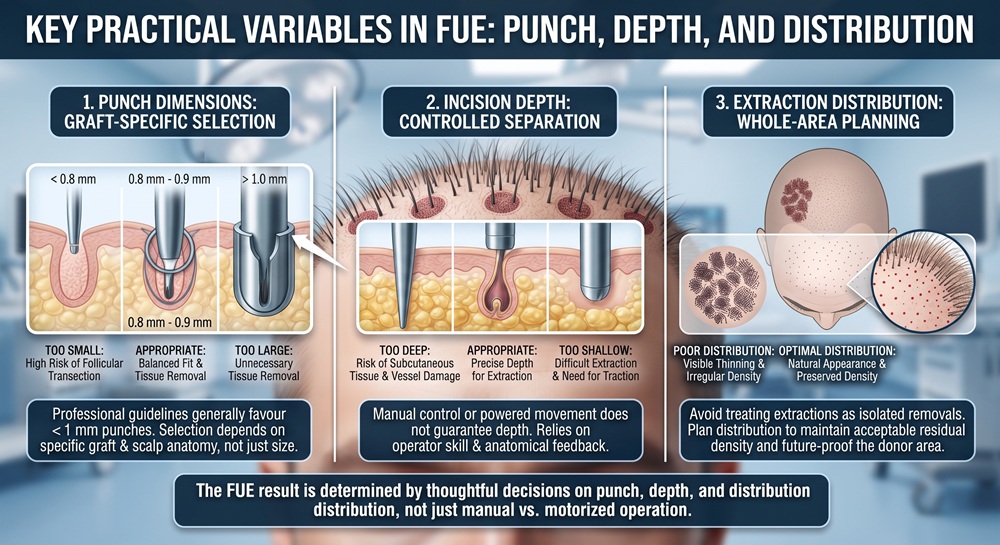
The manual-versus-motorized debate can distract attention from three practical variables: punch dimensions, incision depth and extraction distribution.
Punch diameter: smaller is not automatically better
A smaller punch can reduce the diameter of an individual extraction wound. However, it must still accommodate the anatomy of the follicular unit being harvested.
If the punch is too small for a particular unit or is poorly matched to its configuration, it may increase the difficulty of extraction or contribute to follicular injury. A larger punch may provide more room around a wider or splayed unit, but it also removes more surrounding tissue.
The objective is to select an appropriate instrument for the specific graft and scalp, rather than assuming that the smallest possible punch will always produce the best result.
Professional guidelines generally favour punches below 1 mm and advise against punches larger than 1 mm in routine FUE practice, while recognising that individual clinical factors must guide surgical decisions. [1]
Depth: knowing when to stop
The punch must separate the follicular unit sufficiently for extraction without unnecessarily extending the incision into deeper structures.
Excessive penetration, poor alignment or inappropriate technique can damage grafts and surrounding tissue. Insufficient incision depth can also make extraction more difficult and increase the need for traction.
Manual control does not automatically solve this problem, and powered movement does not inevitably create it. The outcome depends on the instrument, the anatomy and the operator’s control of the incision.
Distribution: the donor area must be planned as a whole
Extraction should not be treated as a series of isolated graft removals. Each decision contributes to the remaining density of the donor region.
The surgeon must consider where grafts can be removed while maintaining an acceptable distribution of residual hair, taking into account existing density, follicular-unit characteristics, any previous harvesting and the patient’s likely future hair-loss pattern.
An extraction plan that focuses exclusively on reaching a target graft count risks overlooking the cumulative aesthetic consequences.
The donor area is not preserved by the punch alone. It is preserved by the decisions made before, during and after extraction.
7. The long-term issue: today’s graft count versus tomorrow’s options
Hair transplantation redistributes existing follicles; it does not increase the patient’s total supply of donor hair.
This makes donor management a long-term consideration, particularly for patients with progressive androgenetic alopecia.
A person who receives a transplant today may experience further hair loss in untreated areas over the following years. If a future procedure becomes desirable or necessary, the availability and condition of the donor area will influence the options that remain.
Excessive extraction can therefore have consequences beyond the initial cosmetic result. It may reduce flexibility for future procedures, complicate repair work or leave visible thinning that cannot easily be corrected.
The appropriate strategy depends on the individual’s diagnosis, the stability and characteristics of the donor region, the expected progression of hair loss and the realistic objectives of treatment.
This is also why a high graft count should not automatically be interpreted as a superior outcome.
A larger session may be appropriate in selected circumstances, but the number of grafts harvested must be considered alongside their quality, the donor area left behind and the patient’s longer-term needs.
Manual extraction cannot guarantee conservative planning. Motorized extraction does not inherently require aggressive harvesting. Either method can be used within a responsible donor-management strategy, provided the clinical decisions are appropriate.
The more useful question is whether the surgeon can explain how the proposed graft count fits the patient’s long-term donor budget.
8. Manual vs. motorized FUE: a practical comparison
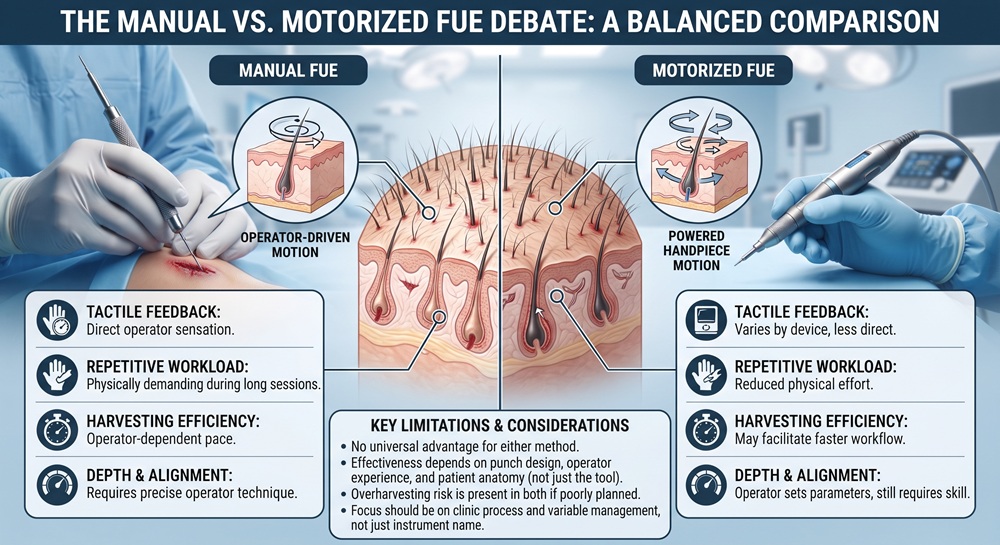
| Consideration | Manual punch | Motorized extraction |
|---|---|---|
| How the punch moves | Driven by the operator’s hand | Driven by a powered handpiece |
| Tactile feedback | Direct feedback through manual operation | Feedback depends on the device and operator’s technique |
| Repetitive workload | Can be physically demanding during long sessions | Can reduce repetitive physical effort |
| Harvesting efficiency | Depends on the operator, instrument and case | May facilitate faster repetitive incision-making |
| Control of depth and alignment | Requires operator judgement and technique | Requires operator judgement and technique |
| Follicular transection | Depends on anatomy, punch design and execution | Depends on anatomy, punch design and execution |
| Risk of overharvesting | Present if planning or distribution is inadequate | Present if planning or distribution is inadequate |
| Donor-area preservation | Depends on surgical planning and execution | Depends on surgical planning and execution |
The comparison reveals an important limitation: neither method has a universal advantage across all the factors that determine donor-area quality.
Manual and motorized systems have different operational characteristics, but their effectiveness cannot be assessed independently of the punch design, the operator’s experience and the patient’s anatomy.
For patients, the practical objective should be to understand how the clinic manages those variables rather than choosing a procedure based on the instrument’s name.
9. Can a hybrid approach offer the best of both methods?
Some surgical workflows use different instruments or movements according to the characteristics of the donor area and the requirements of individual extraction stages.
A hybrid approach may involve adapting the instrument or technique when the operator encounters different follicular configurations or tissue characteristics. Its potential value lies in flexibility, rather than in combining two methods simply because doing so sounds more advanced.
However, hybrid extraction should not be treated as inherently superior either. It introduces its own requirements for training, consistency and decision-making. The relevant question remains whether the selected approach improves control and graft handling in the circumstances in which it is used.
A clinic should be able to explain why a particular method is appropriate for the patient rather than presenting the use of multiple instruments as proof of better surgery.
Technology is most useful when it responds to a defined clinical need.
10. The questions patients should ask before choosing a clinic

Patients comparing hair-transplant providers often encounter claims about advanced motors, manual precision, small punches or high extraction capacity. These descriptions may be useful, but they reveal relatively little about how the donor area will be protected.
A more informative consultation should address the following questions:
- How is my donor area assessed before surgery?
The evaluation should consider density, follicular-unit characteristics, hair calibre, miniaturisation where relevant, previous procedures and the likely progression of hair loss. - Why is this extraction method appropriate for my scalp?
The answer should relate to the patient’s anatomy and the surgeon’s technique, rather than relying on claims that one instrument is universally better. - Who performs the extractions?
Patients should understand the roles of the treating surgeon and the wider surgical team, including who performs the critical stages of harvesting and how clinical oversight is maintained. - How is graft damage monitored?
Ask whether the clinic evaluates transection and graft integrity, how those measurements are defined and how findings influence the surgical process. - How will extraction be distributed across my donor area?
A responsible plan should address residual density and the risk of creating visible irregularities, not merely the total number of grafts to be harvested. - What donor supply might remain if I need another procedure?
The answer should acknowledge uncertainty about future hair loss and avoid presenting a fixed lifetime graft allowance as universally applicable. - What happens if the donor area proves less suitable than expected?
A credible plan should allow for changes in extraction strategy or graft targets when the clinical circumstances warrant them.
These questions shift the discussion away from equipment branding and towards the quality of the clinical decisions that determine the patient’s outcome.
11. What does the evidence actually support?
The available literature supports the importance of instrument selection, appropriate punch design, careful incision technique and donor-area management. It also demonstrates that different extraction mechanisms and punch configurations can influence technical outcomes.
What it does not establish is that manual extraction is always safer, that motorized extraction is always more efficient without compromising quality, or that one method universally preserves more donor hair over the long term.
There are important limitations to the evidence. Studies may compare different devices, punch geometries, movements, operators and patient groups. They may also measure different endpoints, such as transection, graft yield, extraction speed or visible donor changes. These outcomes are related, but they are not interchangeable.
A reduction in transection does not automatically demonstrate better long-term donor density. A faster extraction rate does not prove a better cosmetic result. And a small extraction wound does not guarantee that the overall harvesting pattern will remain inconspicuous.
Long-term donor preservation depends on several interacting factors, including the original donor characteristics, the number and distribution of extractions, the amount of tissue removed, healing and the likelihood of further hair loss.
For this reason, claims of superiority should be supported by relevant comparative evidence rather than inferred from the mechanism of a device.
The most defensible conclusion is that manual and motorized FUE are alternative ways of performing the incision stage of follicular unit excision. Both require sound clinical judgement, and neither removes the biological limitations of the donor area.
Conclusion: the best extraction method is the one that respects the donor area
Manual punch versus motorized extraction is often presented as a contest between traditional craftsmanship and modern technology. That framing is too simplistic for a procedure in which millimetres, follicular angles, tissue characteristics and cumulative extraction patterns can influence the final result.
Manual FUE may offer a preferred form of tactile control for certain operators and cases. Motorized FUE may offer meaningful advantages in repetitive workload and procedural efficiency. The suitability of either method depends on how the instrument is used, how the patient is assessed and how the donor area is managed.
Neither a manual handle nor a powered handpiece can compensate for poor planning. Neither can make donor hair unlimited. And neither should be used as a substitute for a realistic discussion of future hair loss and the possibility of additional treatment.
For anyone evaluating a hair transplant, the most important question is not simply which instrument a clinic uses. It is whether the clinic can explain how its approach protects graft integrity, maintains a natural-looking donor area and preserves as much future flexibility as the patient’s anatomy allows.
Because a successful hair transplant is not measured only by what grows in the recipient area. It is also measured by what remains healthy, natural-looking and usable in the donor area.
References
- Hair Transplant Practice Guidelines. Peer-reviewed clinical practice guidance covering FUE instrumentation, punch selection, follicular transection and overharvesting. Read the guidelines on PubMed Central.
- Gupta AK, et al. Innovations hair restoration surgeons have made to adapt to the challenges of follicular unit excision. Journal of Cosmetic Dermatology, 2020. Read the review on PubMed.
- Kim J, et al. The condition of hair follicles produced by different punching methods during FUE surgery. Journal of Cosmetic Dermatology, 2024. Read the comparative study on PubMed.
- Complications in Hair Transplantation. Peer-reviewed review covering donor-site depletion, visible scarring and complications associated with FUE. Read the review on PubMed Central.
Leave a Reply