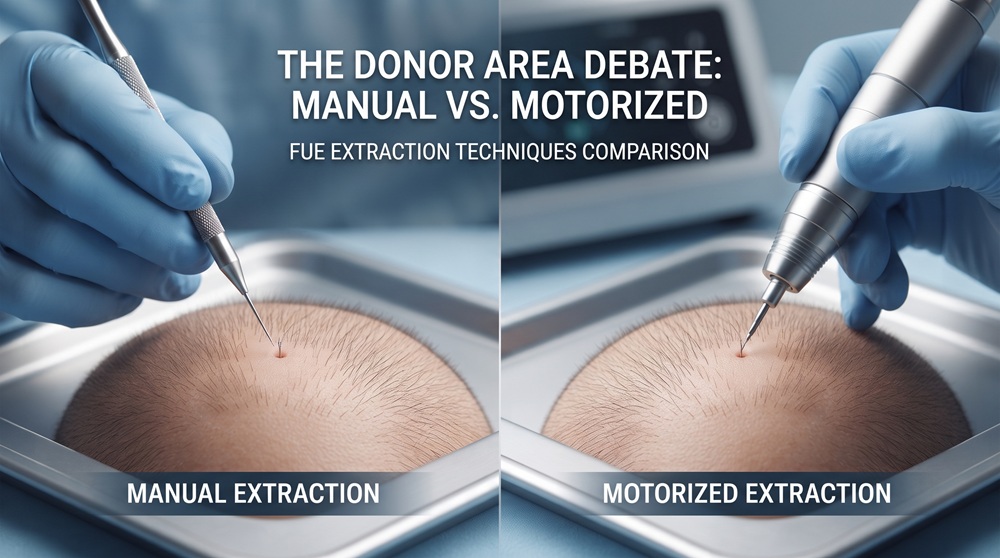
In the evolution of modern hair restoration, surgical tools have undergone dramatic refinements. For decades, traditional Follicular Unit Extraction (FUE) relied exclusively on standard steel blades to create recipient site incisions. While effective, steel tools presented unavoidable physical constraints—such as microscopic surface irregularities, blade degradation during prolonged procedures, and relatively wide incision profiles.
Category: Technology and Science
Welcome to the intersection of medical innovation and aesthetic precision. In this section, we break down the advanced technologies and scientific breakthroughs driving the modern hair restoration industry.
Explore evidence-based insights on Sapphire FUE vs. DHI mechanics, bio-active PRP integration, and cutting-edge regenerative medicine designed to optimize graft survival and accelerate healing. Understand the science behind your journey and make fully informed clinical decisions.
-

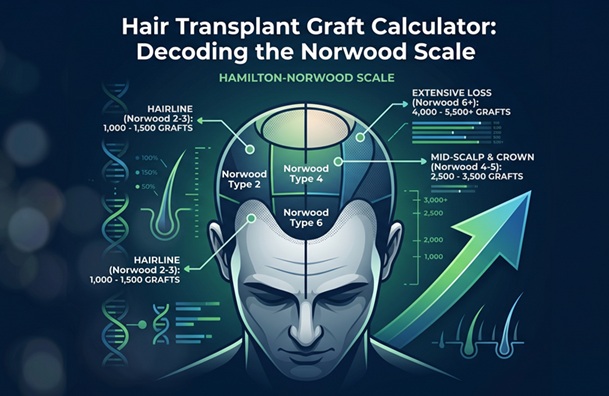
Hair Transplant Graft Calculator: How Many Grafts Do You Need Based on the Norwood Scale?
Medical Review: This content is supervised and verified by
Dr. Güncel Öztürk.Determining how many hair grafts you need is one of the most critical steps when planning a hair restoration procedure. Rather than relying on guesswork, hair transplant surgeons use the Norwood Scale—the universal classification system for male pattern baldness—to measure progressive hair loss and calculate precise graft requirements.
In this comprehensive guide, we break down how surgeons evaluate donor capacity, estimate graft counts per Norwood stage, and select the optimal surgical technique (Sapphire FUE or DHI) for maximum density and natural results.
-

Needle-Free Anesthesia: Does “Painless” Hair Transplant Really Exist?
Medical Review: This content is supervised and verified by
Dr. Hamit Göz.An objective, clinical analysis of jet-injection mechanisms, scalp neuroanatomy, and the hybrid protocols used in modern trichological surgery.
The global proliferation of hair restoration surgery, particularly within high-volume medical tourism hubs like Istanbul, has driven unprecedented technological evolution. However, alongside genuine surgical innovations such as Sapphire FUE and Direct Hair Implantation (DHI), the industry has witnessed a parallel surge in aggressive marketing buzzwords. Among these, the promise of a “completely painless hair transplant” achieved via “needle-free anesthesia” stands out as one of the most compelling selling points for prospective patients.
-

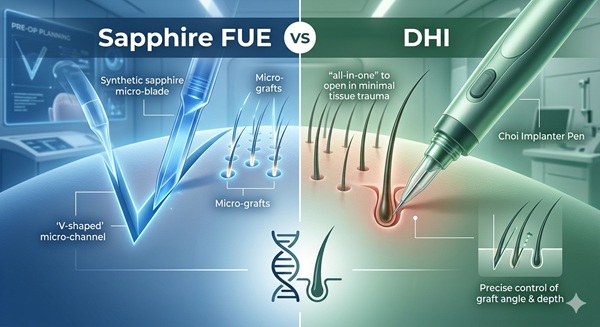
Sapphire FUE vs. DHI: Which One is Right for Your Hair Type?
Medical Review: This content is supervised and verified by
Dr. Hamit Göz.The field of hair restoration surgery has transitioned from mere hair replacement to a sophisticated discipline focused on natural aesthetics and graft survivability. Today, the choice between Sapphire Follicular Unit Extraction (FUE) and Direct Hair Implantation (DHI) represents the pinnacle of this evolution. While both methods utilize the same extraction principle—harvesting individual follicular units—their implantation phases differ significantly in terms of surgical trauma, graft handling, and suitability for specific hair types.