
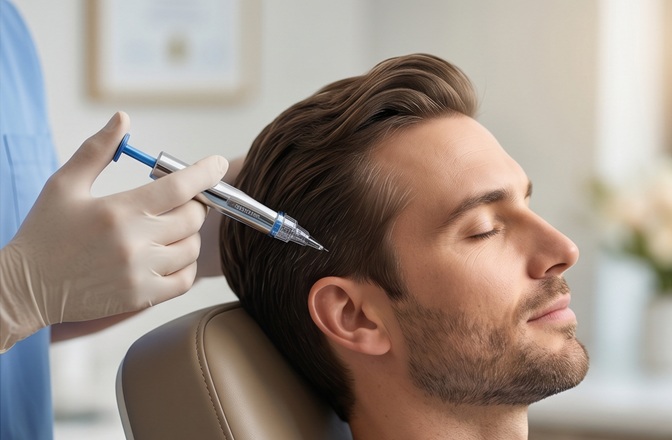
Medical Review: This content is supervised and verified by
Dr. Hamit Göz.
An objective, clinical analysis of jet-injection mechanisms, scalp neuroanatomy, and the hybrid protocols used in modern trichological surgery.
The global proliferation of hair restoration surgery, particularly within high-volume medical tourism hubs like Istanbul, has driven unprecedented technological evolution. However, alongside genuine surgical innovations such as Sapphire FUE and Direct Hair Implantation (DHI), the industry has witnessed a parallel surge in aggressive marketing buzzwords. Among these, the promise of a “completely painless hair transplant” achieved via “needle-free anesthesia” stands out as one of the most compelling selling points for prospective patients.
For a significant percentage of the population, medical anxiety is deeply intertwined with trypanophobia—the fear of hypodermic needles. Consequently, the prospect of undergoing an autologous follicular unit extraction (FUE) involving thousands of grafts without a single needle stick is immensely attractive. But what is the clinical reality behind these claims? Does needle-free anesthesia truly eliminate pain, or is it a sophisticated marketing veil draped over standard surgical protocols? To understand the answer, we must dissect the physics of jet injectors, the neuroanatomy of the human scalp, and the physiological limits of local anesthetic infiltration.
The Physics and Mechanics of Needle-Free Jet Injectors
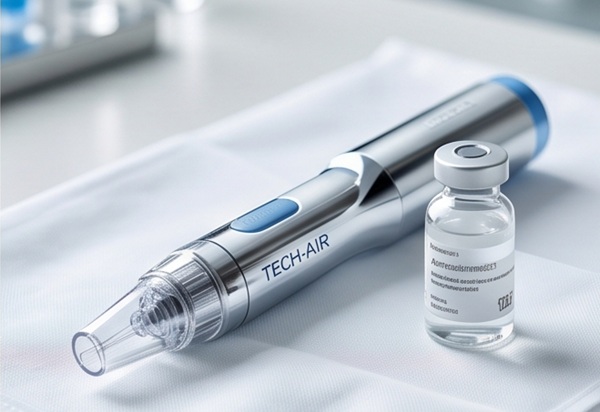
Traditional local anesthesia in hair transplantation relies on hypodermic needles (typically 27G to 30G) connected to a manual syringe or an electronic delivery system. The needle physically penetrates the epidermis and dermis to deposit an anesthetic solution—usually a combination of lidocaine, bupivacaine, and epinephrine—into the subcutaneous tissue layer.
In contrast, needle-free anesthesia systems (commercially known under brands like Comfort-In, Dermojet, or MitX) eliminate mechanical skin penetration by utilizing liquid jet kinetics. The core mechanism relies on a high-pressure spring-loaded or electronically controlled piston. This piston forces the liquid anesthetic through a micro-orifice measuring approximately 0.15 millimeters in diameter—considerably smaller than the finest surgical needle.
When the device is actuated, it generates a high-velocity, ultra-fine liquid jet capable of reaching speeds up to 200 meters per second. The kinetic energy produced by this velocity allows the liquid stream to literally punch through the stratum corneum, epidermis, and upper dermis. Once inside the tissue, the liquid jet disperses outward in a cone-shaped geometry, distributing the anesthetic solution uniformly across the superficial nerve endings. This process is known as interstitial infiltration via barometric pressure.
Neuroanatomy of Scalp Pain: Why Anesthesia is Required
To evaluate whether a procedure can be genuinely painless, one must analyze the sensory pathways of the surgical site. The human scalp is one of the most highly vascularized and densely innervated regions of the body. Sensory perception across the donor (occipital and temporal) and recipient (frontal and vertex) areas is governed by a complex network of cranial and spinal nerves:
- Anterior Scalp: Innervated by the supratrochlear and supraorbital branches of the ophthalmic nerve (V1 branch of the trigeminal nerve).
- Lateral Scalp (Temporal Region): Innervated by the zygomaticotemporal and auriculotemporal nerves.
- Posterior Scalp (Donor Zone): Heavily innervated by the greater occipital nerve (C2), lesser occipital nerve (C2, C3), and third occipital nerve.
These nerves branch into a vast web of myelinated A-delta fibers (responsible for sharp, immediate pain signaling) and unmyelinated C fibers (responsible for dull, aching pain and thermal sensations) terminating in nociceptors within the dermis and subcutaneous adipose tissue. During the harvesting phase with a micro-punch or the recipient site creation with a sapphire blade, these nociceptors are subject to intense mechanical trauma. Without a complete chemical blockade of voltage-gated sodium channels along these nerve pathways, the procedure would be intolerable.
The Clinical Reality: Does “Painless” Truly Exist?
The objective medical answer is nuanced: Needle-free anesthesia reduces the specific sharp pain of needle insertion, but it is not entirely perception-free, nor does it replace needles entirely throughout the entire operation.
When the needle-free injector is pressed against the scalp and fired, the patient does not feel a needle puncture, but they do experience a distinct mechanical sensation. This is frequently described as a sharp slap, a high-pressure “pop,” or a stinging sensation akin to being snapped by a thick rubber band. Because the fluid must force its way through solid tissue layers under extreme pressure, the sudden expansion of the interstitial space triggers localized pressure-sensitive nociceptors (mechanoreceptors).
Furthermore, the pharmacological volume capacity of needle-free jet injectors is structurally limited. Most jet delivery systems can only administer between 0.1 ml and 0.5 ml of solution per discharge. Attempting to achieve a deep, widespread nerve block over the entire occipital donor zone using only a jet injector would require hundreds of high-pressure discharges, leading to significant superficial tissue micro-trauma, bruising (ecchymosis), and localized barotrauma.
The Structural Depth Limitation
A crucial limiting factor of needle-free systems is their depth of penetration. Jet injectors are highly effective at numbing the epidermis and the papillary and reticular dermis. However, hair follicles—especially healthy terminal grafts in the donor area—rely on bulbs rooted deep within the subcutaneous adipose tissue layer, sometimes up to 4 to 5 millimeters beneath the surface. Jet injectors cannot safely or reliably deliver large volumes of anesthetic fluid to this deep subcutaneous layer without risking vascular damage or severe skin necrosis due to excessive localized pressure.
The Hybrid Protocol: How High-Quality Clinics Actually Operate
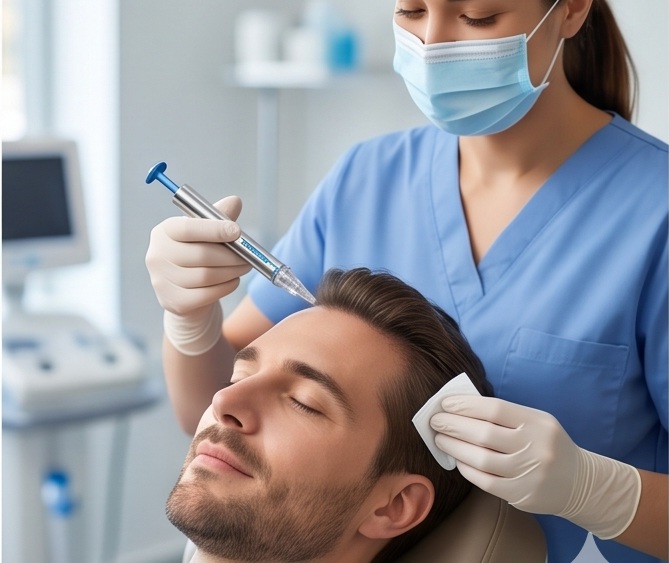
Because of these anatomical and structural limitations, ethical and clinically advanced hair transplant clinics in Turkey do not use needle-free anesthesia as a standalone solution. Instead, they implement a Two-Step Hybrid Anesthesia Protocol. This method leverages the benefits of both technologies to maximize patient comfort:
Step 1: The Superficial Needle-Free Block
The surgeon or specialized technician utilizes the needle-free jet injector to map out a preliminary ring of anesthesia along the border of the donor or recipient area. This creates a series of localized, superficial “numb windows” or entry portals where the dermal nociceptors are completely blocked within seconds.
Step 2: The Deep Tumescent Needle Infiltration
Once the superficial skin layers are fully desensitized by the jet injector, the medical team introduces a traditional, ultra-fine hypodermic needle. Crucially, the needle is inserted exclusively through the entry points that were just numbed in Step 1.
Through these anesthetized portals, the surgeon can painlessly slide the needle deeper into the subcutaneous layer to administer the large volumes of tumescent solution required for the surgery. Tumescent anesthesia—a mixture of saline, lidocaine, and epinephrine—is mandatory in FUE surgery. It causes the subcutaneous tissue to swell and become rigid, physically separating the follicular units from the underlying major occipital arteries and deep nerves. This fluid cushion protects the donor site from transection and minimizes bleeding, but it can only be delivered via a needle or cannula.
The Sedation-Assisted Clinical Variant: For patients exhibiting severe, acute trypanophobia or generalized surgical anxiety, modern clinical practice frequently enhances this hybrid protocol by incorporating light intravenous sedation (analgesia). Administering a mild sedative prior to the procedure ensures that the initial phase—including the mechanical impact of the jet injector—is entirely stress-free, establishing complete psychological and physiological comfort before local infiltration begins.
Comparative Matrix: Jet Injection vs. Traditional Needle Injection
| Parameter | Needle-Free Jet Injection | Traditional Hypodermic Needle |
| Primary Sensation | High-pressure snap, blunt impact, localized sting. | Sharp puncture, burning sensation during fluid entry. |
| Penetration Depth | Superficial (Epidermis to Upper Dermis). | Adjustable/Deep (Dermis to Deep Subcutaneous). |
| Volume Capacity | Very Low (0.1 ml – 0.5 ml per discharge). | High (Unlimited volume delivery via syringe). |
| Tumescent Suitability | Unsuitable for deep tissue expansion. | Essential for subcutaneous fluid cushioning. |
| Patient Anxiety | Extremely low; highly psychological comfort. | High trigger for trypanophobic patients. |
Potential Side Effects and Technical Considerations
While the hybrid protocol represents a major milestone in patient-centered care, needle-free devices are not without technical drawbacks. Medical teams must carefully calibrate these devices based on individual patient skin characteristics:
- Scalp Fibrosis and Thickness: Patients with highly dense, fibrotic, or thick scalps may experience inadequate penetration from a jet injector, causing the liquid to deflect off the stratum corneum and fail to achieve anesthesia.
- Localized Edema and Hematoma: The intense pressure required to force fluid through the dermis can occasionally rupture superficial capillaries, leading to minor localized bleeding, bruising, or skin welts.
- Acoustic Startle Reflex: Jet injectors operate via a loud mechanical clicking or popping sound. For anxious patients, this sudden sound close to the ear can trigger a startle reflex if not properly warned beforehand.
Patient E-E-A-T Checklist: How to Evaluate Clinic Claims
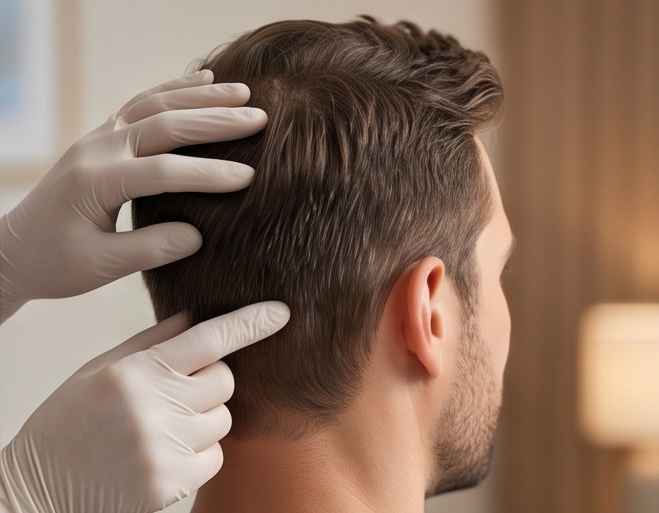
When researching hair transplant clinics via international directories and comparison portals like our directory of hair transplant clinics, patients must maintain a critical, informed perspective regarding commercial advertising. If a clinic claims that their procedure is 100% painless and completely devoid of needles from start to finish, patients should ask the following technical questions during their pre-consultation:
Do you use a hybrid protocol?
Confirm if the needle-free system is used solely for initial superficial numbing before tumescent fluid is introduced.
What specific device is used?
Reputable clinics utilize medical-grade, certified jet injectors with single-use, sterile nozzles to prevent cross-contamination.
Who administers and oversees the anesthesia protocol?
Because local anesthetics carry potent cardiotoxic risks if mismanaged, and jet injectors operate under intense pressure, the procedure must always be executed directly by, or under the strict and constant supervision of, qualified medical professionals or anesthesiologists who fully master scalp vascular networks.
Conclusion
Needle-free anesthesia is an invaluable asset in modern hair restoration surgery. It effectively eliminates the most feared aspect of the procedure: the initial, painful needle pricks into a highly sensitive, un-numbed scalp. It transforms the opening phase of surgery from a painful ordeal into a highly manageable, low-anxiety experience.
However, an absolute, needle-free, entirely painless hair transplant is a medical impossibility given the deep anatomical localization of hair roots and the physiological necessity of deep tumescent fluid infiltration. The absolute key to a successful, safe, and comfortable hair transplant does not lie in magic marketing terms, but in the skilled deployment of a hybrid protocol by transparent, medically ethical clinics.
Leave a Reply