

Medical Review: This content is supervised and verified by
Dr. Hamit Göz.
Introduction: The Golden Window of Hair Restoration
The completion of a hair transplant surgery—whether utilizing Follicular Unit Extraction (FUE) or Direct Hair Implantation (DHI)—is a major milestone. However, the physical exit from the operating room does not mark the end of the procedure’s success; rather, it initiates the most critical phase of the entire hair restoration journey: the first 72 hours post-op. This specific time frame represents a delicate biological window where the newly implanted follicular units are highly vulnerable, unanchored, and completely dependent on meticulous external care to survive.
For international patients traveling to major hair restoration hubs like Turkey, navigating these initial three days can feel overwhelming. The scalp is recovering from thousands of micro-traumas, local anesthesia is wearing off, and the psychological anxiety of protecting the financial and emotional investment kicks in. Mismanagement during this 72-hour window—such as accidental friction, improper sleeping posture, or premature washing—can permanently dislodge grafts, leading to irreversible patchy growth or donor-site complications. This comprehensive, step-by-step clinical guide deconstructs the first 72 hours post-transplant, providing actionable, medical-grade protocols to guarantee optimal graft survival and a seamless recovery.
The Cellular Biology: Why the First 72 Hours Matter
To understand the strictness of post-operative protocols, patients must understand the underlying science of graft anchoring. When a follicular unit is excised from the donor zone and placed into a recipient channel, it is completely severed from its original blood supply. It sits in the new micro-incision like a plant cutting in soil.
During the first 24 to 48 hours, the grafts are held in place solely by a natural biological adhesive: a fragile matrix of fibrin clots (blood coagulation factors). It takes approximately 72 hours for the surrounding dermal tissue to initiate endothelial adhesion and begin the primitive stages of revascularization (connecting the graft to the scalp’s microscopic blood vessels). Until this 72-hour threshold is crossed, the grafts possess zero mechanical stability. The slightest rub against a bedframe, a tight t-shirt, or a car door frame can effortlessly pluck the follicle clean out of its channel, ending its growth potential permanently.
Day 1: Hours 1 to 24 – The Critical Transition
The first 24 hours are defined by the stabilization of the scalp, managing the immediate after-effects of local tumescent anesthesia, and preventing any form of mechanical displacement.
1. Immediate Post-Op and the Journey Home
Immediately after surgery, the surgical team applies a sterile protective bandage to the donor area, while the recipient area remains completely exposed to prevent friction. When entering a taxi or transport vehicle to return to the hotel, patients must exercise extreme spatial awareness. Lower your head significantly when entering the vehicle to eliminate any risk of scraping the hairline against the door frame.
2. Managing Oozing and Fluid Drainage
It is entirely normal to experience minor bleeding and the leakage of a clear, yellowish fluid (serosanguinous fluid mixed with leftover tumescent anesthesia) from both the donor and recipient areas during the first 12 hours. Do not panic. If fluid trickles down, gently dab it with a sterile gauze pad, but only on the forehead or face—never touch or dab the recipient area directly. Let any fluid on the recipient site dry naturally into micro-scabs.
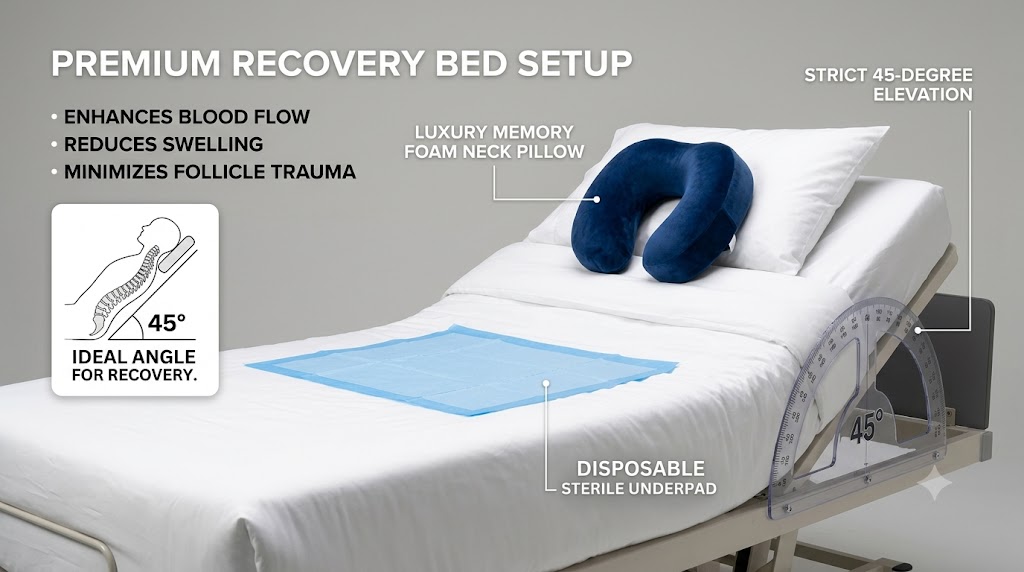
3. The 45-Degree Sleeping Protocol
Sleeping on the first night requires absolute adherence to a mechanical protocol to prevent both graft friction and the severe accumulation of facial edema (swelling).
- The Position: You must sleep strictly on your back, with your torso elevated at a 45-degree angle. This is best achieved by using a firm reclining chair or stacking multiple pillows under your mattress and back.
- The Tool: Utilize an ergonomic, inflatable or memory-foam travel neck pillow. The travel pillow stabilizes the neck and prevents your head from rolling sideways during the night, keeping the recipient area completely suspended in the air and untouched.
- The Protection: Place a clean, disposable medical pad (underpad) over your bed pillows to absorb any anesthesia drainage leaking from the donor area bandage.
Clinical Note: Never sleep face down or flat on your side during the first 72 hours. Gravity will cause the surgical fluids to migrate downward into your eyelids and forehead, causing massive, painful swelling.
Day 2: Hours 24 to 48 – The Peak of Edema and Protection
By the second day, the immediate surgical shock begins to subside, but the body initiates its natural inflammatory response to the micro-traumas.
1. Combating Facial Swelling (Edema)
Day 2 is typically when swelling becomes visible around the forehead and between the eyes. This is the fluid anesthesia migrating downward. To manage this safely:
- Apply a cold compress or ice pack to your forehead and around the eye orbital bones for 10 minutes every hour. Absolute Warning: Never allow the ice pack to touch or come within 5 centimeters of the implanted grafts.
- Maintain high hydration levels by drinking 2.5 to 3 liters of water. This flushes the lymphatic system and accelerates the excretion of surgical fluids.
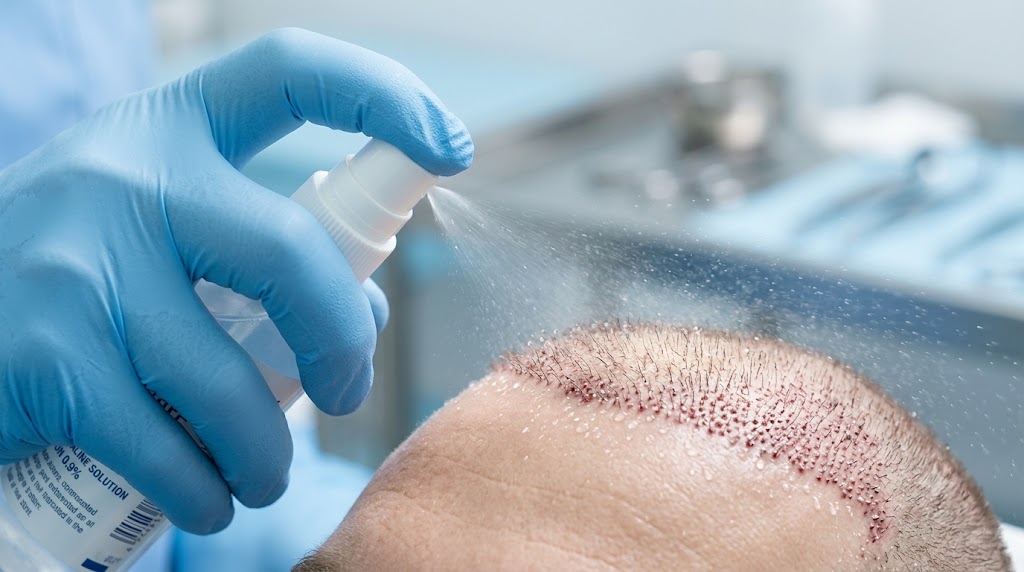
2. The Hydration Spray Protocol
Many elite clinics in Turkey provide patients with a sterile saline spray or specialized liposomal solution upon discharge. Starting on Day 2, you should gently mist the recipient area every 30 to 60 minutes. Hold the spray bottle approximately 20 to 30 centimeters away from the scalp and allow a fine, gentle fog to settle over the grafts. This prevents the micro-scabs from drying out aggressively, reduces itching, and keeps the follicles hydrated without generating mechanical pressure.
Day 3: Hours 48 to 72 – The First Washing Milestone
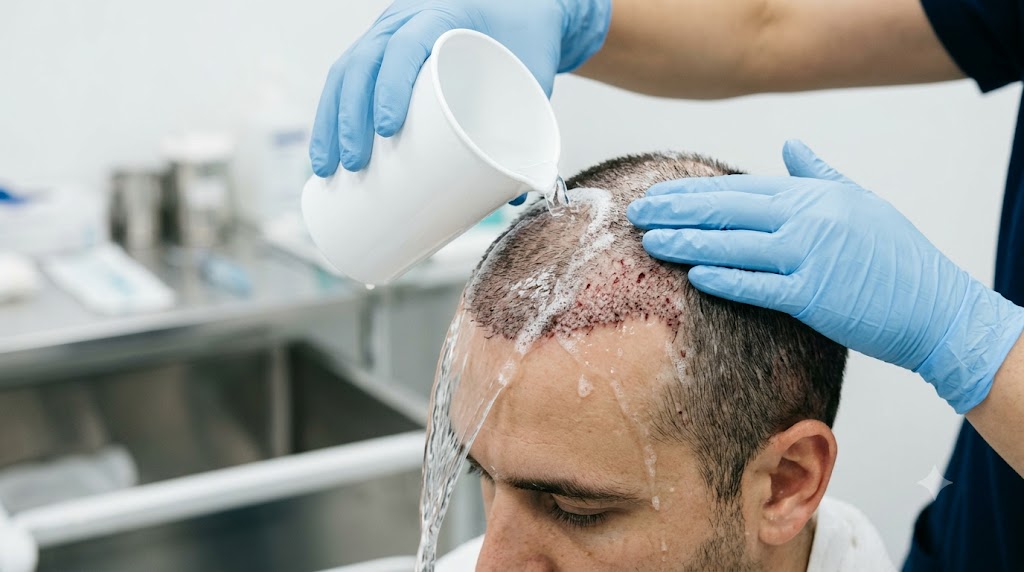
The 48-to-72-hour mark marks the transition where the donor area bandage is removed (usually at the clinic during a post-op checkup) and the first official scalp wash occurs. This process must be executed with extreme clinical delicacy.
The Step-by-Step Gentle Washing Protocol
If you are executing the first wash at home or in your hotel, follow this precise sequence to avoid damaging the clotting matrix:
- Lotion/Panthenol Application: Gently pour a thin layer of the clinic-provided moisturizing lotion or Panthenol foam over the recipient area. Do not rub, slide, or massage it. Simply tap it on with the flats of your clean fingers or let the foam settle naturally. Allow it to sit for 20 to 30 minutes to soften the forming scabs.
- The Rinsing Phase: Rinse the lotion off using lukewarm water. Never let direct water pressure from a shower head hit your scalp. Instead, fill a clean bowl or cup with water and gently pour it over your head, allowing the water to cascade smoothly across the grafts. Alternatively, use a manual spray bottle on a very soft mist setting.
- Shampoo Application: Dilute the recommended medical, paraben-free shampoo with a bit of water in your palms until it lathers. Gently tap the foam onto the recipient and donor areas. Again, absolutely zero rubbing or circular motions are allowed on the grafts.
- The Final Rinse and Drying: Cascade lukewarm water over the scalp until all soap residue is cleared. To dry, allow the scalp to air-dry naturally. Never use a towel to dry the recipient area, and do not use a hair dryer, as the thermal heat can damage the vulnerable, denervated tissue.
Quick Reference Guide: The 72-Hour Post-Op Matrix
To help you track your recovery milestones, consult this simplified daily operational matrix:
| Time Frame | Primary Focus | Crucial Action Required | Absolute Prohibition |
|---|---|---|---|
| Hours 1 – 24 | Graft stabilization & Drainage | Sleep at a 45° angle with a travel pillow. Dab fluids only from the face. | No touching the recipient zone; no sleeping flat or face down. |
| Hours 24 – 48 | Edema control & Graft hydration | Apply ice to forehead (not grafts). Spray saline mist every 30-60 mins. | No scratching, picking scabs, or wearing caps/hats. |
| Hours 48 – 72 | First wash & Donor healing | Execute the first gentle cup-rinse wash with Panthenol and clinical shampoo. | No direct shower head pressure; no towel drying; no physical exertion. |
The “Never-Do” Rules for the First 72 Hours
While doing the right things is essential, avoiding the wrong things is arguably more critical during this fragile window. Memorize these absolute clinical prohibitions:
- No Nicotine and Alcohol: Nicotine is a potent vasoconstrictor that narrows blood vessels, drastically restricting oxygen delivery to the unanchored grafts. Alcohol thins the blood, increasing post-op bleeding and oozing. Avoid both completely.
- No Medication Modification: Always take your prescribed antibiotics and anti-inflammatory medications exactly as detailed by your surgeon. Do not take aspirin or ibuprofen unless explicitly cleared, as they can exacerbate bleeding.
- No Physical Exertion: Any activity that increases your heart rate or blood pressure—including lifting heavy luggage, brisk walking, bending down forward, or sexual activity—can cause the fragile micro-clots at the graft bases to rupture, forcing the follicles out of their channels.
- No Headwear: Baseball caps, beanies, or tight hats must be avoided. If you must go outside into direct sunlight, only use an extremely loose, wide-brimmed safari hat that has been structurally verified not to touch any part of the recipient area.
Conclusion: Protecting Your Lifelong Investment
The journey to a full, dense head of hair requires a partnership between the surgical precision of your medical team and your own personal discipline during the post-operative phase. The first 72 hours demand hyper-vigilance, patience, and meticulous compliance with sanitization and structural protocols. By prioritizing rest, maintaining the 45-degree sleeping elevation, preventing physical contact, and executing the first wash with absolute gentleness, you provide your grafts with the perfect micro-environment needed to anchor successfully, ensuring a lifetime of natural, healthy hair growth.
Leave a Reply