
Medical Review: This content is supervised and verified by
Dr. Güncel Öztürk.
Determining how many hair grafts you need is one of the most critical steps when planning a hair restoration procedure. Rather than relying on guesswork, hair transplant surgeons use the Norwood Scale—the universal classification system for male pattern baldness—to measure progressive hair loss and calculate precise graft requirements.
In this comprehensive guide, we break down how surgeons evaluate donor capacity, estimate graft counts per Norwood stage, and select the optimal surgical technique (Sapphire FUE or DHI) for maximum density and natural results.
What Is a Hair Graft and How Is It Calculated?
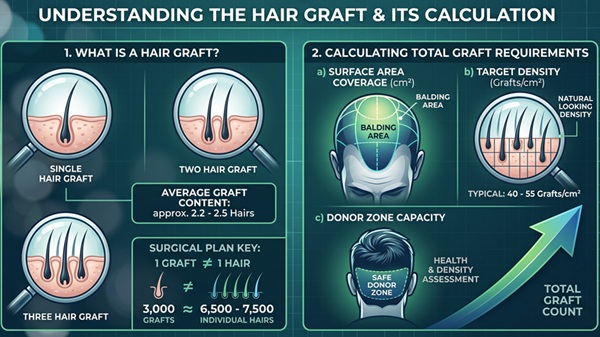
A hair graft (or follicular unit) is a naturally occurring group of 1 to 4 individual hair follicles. On average, a single graft contains approximately 2.2 to 2.5 hairs. This distinction is essential when reading surgical plans: 3,000 grafts equal roughly 6,500 to 7,500 individual hairs.
During a clinical assessment, hair restoration specialists calculate total graft requirements based on three primary variables:
- Surface Area Coverage (cm²): The size of the balding or thinning region needing restoration.
- Target Density: Typically 40 to 55 grafts per square centimeter ($cm^2$) to achieve natural, full-looking density without compromising scalp blood supply.
- Donor Zone Capacity: The health, thickness, and density of hair follicles in the safe donor zone (the back and sides of the scalp).
Hair Transplant Graft Estimator: The Norwood Scale Breakdown
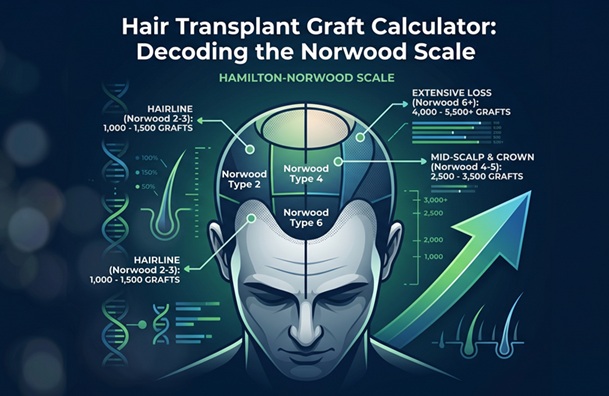
The Hamilton-Norwood Scale classifies male pattern hair loss into 7 distinct stages. Below is the clinical breakdown of estimated graft requirements for each stage:
| Norwood Stage | Hair Loss Characteristics | Estimated Graft Range | Primary Focus Area |
|---|---|---|---|
| Norwood Stage 2 | Minor bitemporal recession (mature hairline). | 1,000 – 1,500 grafts | Temple reinforcement & hairline touch-up |
| Norwood Stage 3 | Deepening recession at the temples; official onset of clinical alopecia. | 1,800 – 2,800 grafts | Frontal hairline reconstruction |
| Norwood Stage 3 Vertex | Receding hairline combined with early thinning at the crown (vertex). | 2,500 – 3,500 grafts | Frontal hairline + crown density |
| Norwood Stage 4 | Severe frontal recession with noticeable thinning across the vertex. | 3,000 – 4,000 grafts | Frontal mid-scalp & vertex restoration |
| Norwood Stage 5 | Extensive loss across the front and crown with a narrowing band of hair separating them. | 4,000 – 4,500 grafts | Full top-head reconstruction |
| Norwood Stage 6 | The bridge between front and crown disappears completely, leaving a wide balding area. | 4,500 – 5,500+ grafts | Multi-session mega-session / Body hair extraction |
Clinical Analysis by Stage
Norwood 2 to 3: Hairline Framing
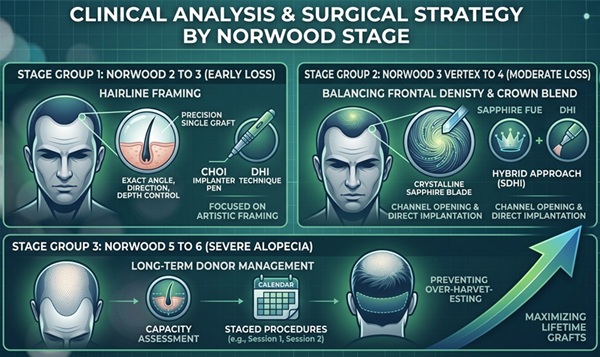
Patients in the early stages of male pattern baldness typically require hairline reconstruction. For Norwood 2 and 3, precision is far more important than sheer volume. Techniques like DHI (Direct Hair Implantation) with Choi Implanter Pens allow surgeons to control the exact angle, direction, and depth of single-hair grafts to frame the face naturally.
Norwood 3 Vertex to 4: Mid-Scalp and Crown Blend
At Stage 4, surgical strategy must balance density between the frontal hairline and the whorl of the crown. Many top clinics in Turkey utilize hybrid approaches (such as SDHI), opening micro-channels in the crown using crystalline Sapphire blades while directly implanting high-density single grafts along the hairline.
Norwood 5 to 6: Overcoming Severe Alopecia
Treating advanced hair loss requires long-term donor management. Extracting more than 4,500 to 5,000 grafts in a single day risks over-harvesting, which can leave the donor area looking patchy or moth-eaten. To restore a Norwood 6 safely, reputable clinics often split treatment into two separate sessions spaced 8 to 12 months apart.
Key Medical Factors That Impact Your Graft Count
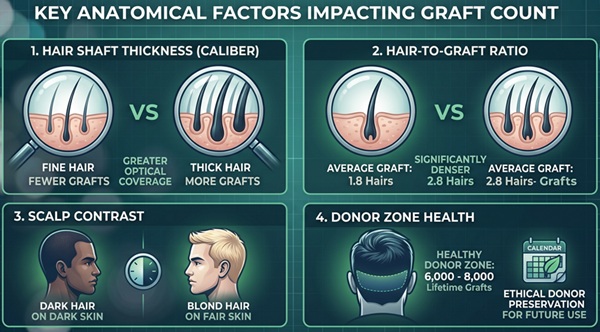
The Norwood Scale serves as a foundational baseline, but individual anatomical variations determine your final surgical plan:
- Hair Shaft Thickness (Caliber): Patients with thick, coarse hair achieve greater optical coverage with fewer grafts compared to patients with fine or thin hair shafts.
- Hair-to-Graft Ratio: An individual whose grafts average 2.8 hairs per unit will achieve significantly denser results than someone averaging 1.8 hairs per unit using the exact same graft count.
- Scalp Contrast: Low contrast between hair color and scalp skin (e.g., dark hair on dark skin or blond hair on fair skin) creates the illusion of higher density.
- Donor Zone Health: A healthy donor zone provides between 6,000 and 8,000 lifetime harvestable grafts. Preserving a portion of this supply for potential future hair loss is a hallmark of ethical surgery.
Frequently Asked Questions About Graft Calculation
Can you transplant 5,000 or more grafts in a single session?
What is the difference between a hair graft and a hair strand?
How many grafts are needed for a typical hairline restoration?
How do surgeons prevent donor area over-harvesting?
Medical fact-checked by TurkHairIndex Editorial Team
Need an Exact Assessment for Your Hair Loss Stage?
Compare top certified hair transplant clinics in Istanbul by surgical technique, surgeon experience, and transparent pricing.
Leave a Reply