
Medical Review: This content is supervised and verified by
Dr. Nesim Tüğen.
Panicking because your transplanted hair is falling out at Month 2? Discover the science of shock loss, why shedding is a sign of regrowth, and how to protect your scalp during the “ugly duckling” phase.
You survived the surgical procedure, meticulously washed your scalp for ten days, and watched the scabs gently fall away. For a brief couple of weeks, you caught a glimpse of your new hairline—and it looked fantastic.
Then, around week 3 or 4, the nightmare begins: the newly transplanted hairs start falling out in the shower, on your pillow, and when you touch your head. By Month 2, your scalp looks almost as bare as it did before the surgery—or sometimes even sparser.
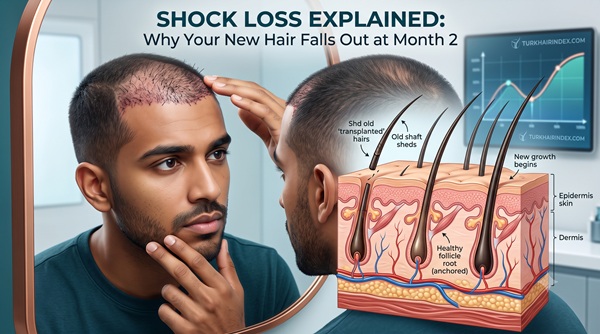
If you are currently staring at the mirror at Month 2 wondering if your hair transplant failed, take a deep breath. This is not a failure. It is a completely normal, biological necessity called Shock Loss.
Here is the exact scientific breakdown of why shock loss happens, the crucial difference between graft loss and shaft shedding, and how to navigate Month 2 with total confidence.
What Is Shock Loss? (The Biology of the “Reset”)
To understand shock loss, you first need to understand that a hair transplant does not actually move “hairs”—it moves hair follicles (the microscopic root factories beneath the skin).
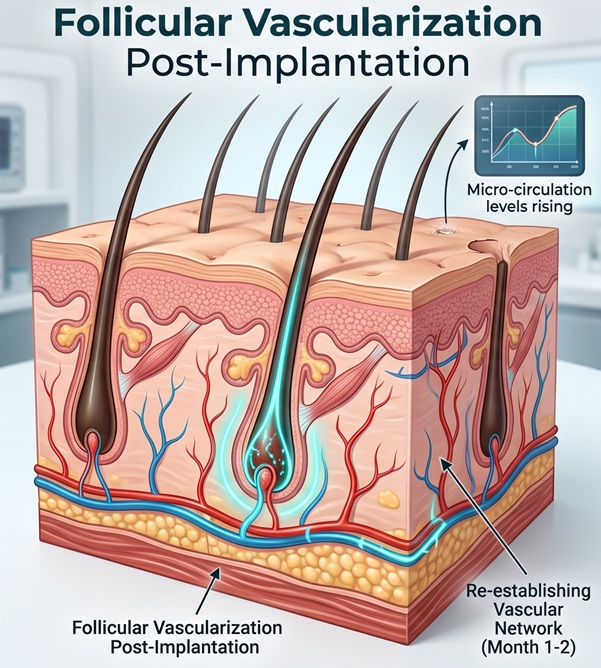
When hair follicles are extracted from the donor area (via FUE or DHI) and implanted into the recipient channels, they suffer a temporary disruption in their oxygen and blood supply. Although the follicle root quickly anchors itself into the scalp within 7 to 10 days, the physical trauma of the surgery forces the hair cycle into a survival state.
The Hair Growth Cycle & Surgical Trauma
Hair naturally moves through three main phases:
- Anagen: The active growth phase (2–6 years).
- Catagen: The short transition phase (2–3 weeks).
- Telogen: The resting and shedding phase (2–4 months).
The surgical trauma forces the newly transplanted follicles to abruptly exit the Anagen (growth) phase and plunge directly into the Telogen (resting/shedding) phase. This sudden, mass transition is known medically as Telogen Effluvium, or colloquially as Shock Loss.
The Gold Standard Rule: Under normal healing conditions, the hair shaft sheds while the follicle root remains securely anchored beneath your scalp to build a brand-new, healthy hair structure. (Note: True graft loss is rare post-anchoring, though overall graft survival depends on crucial surgical factors like tissue hydrated storage time, careful handling to prevent desiccation, and patient lifestyle factors like avoiding smoking).
Transplanted Shedding vs. Native Hair Shock Loss
Shock loss can affect two different types of hair on your scalp during Month 2:
| Feature | Transplanted Hair Shedding | Native Hair Shock Loss |
|---|---|---|
| What Falls Out? | The newly grafted hair shafts. | Pre-existing original hair around the graft site. |
| Frequency | Vast majority of patients (near universal). | Experienced on average by ~15–30% of patients. |
| Cause | Trauma of extraction and re-implantation. | Micro-swelling, vascular stress, and local trauma. |
| Is it Permanent? | No. Completely temporary. | No. Native hairs almost always regrow within 3–4 months. |
Why Does Surrounding Native Hair Fall Out Too?
If you had thinning hair in the recipient area prior to surgery, the local anesthetic, minor surgical incisions, and temporary tissue swelling can cause surrounding native follicles to enter a temporary resting phase as well.
As long as those native hairs were not already at the absolute end of their genetic lifespan (miniaturized beyond recovery), they will grow back alongside your new transplanted hair.
The Hair Transplant Timeline: What Happens at Month 2?
Month 2 is universally referred to by hair restoration surgeons as the “Ugly Duckling Phase.” Understanding where you are on the timeline helps eliminate post-op anxiety.
- Weeks 1–2: Healing & Scab Removal (Grafts Anchor)
- Weeks 3–8: SHOCK LOSS PHASE (Transplanted hairs shed) ← YOU ARE HERE
- Months 3–4: Dormancy Phase (Scalp looks quiet/empty)
- Months 4–6: Early Regrowth Begins (~30-40% density)
- Months 12–18: Full Final Results (100% maturity & thickness)
During Weeks 4 to 8:
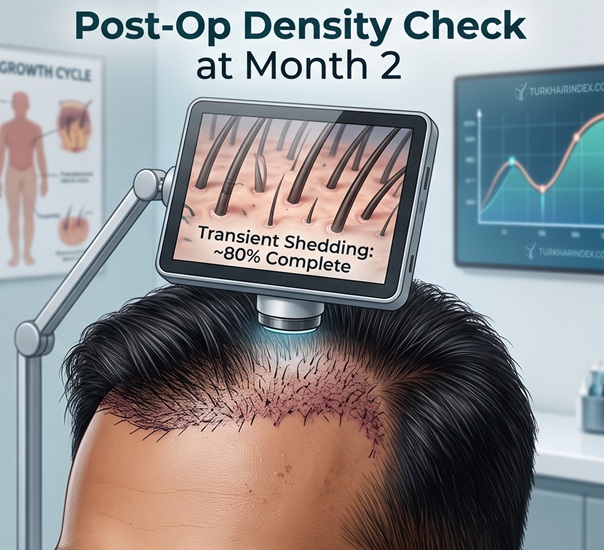
- On average, an estimated 80%–90% of your transplanted hair shafts will shed.
- The recipient area may still look slightly pink or red (especially in fair-skinned patients).
- The scalp might feel numb, itchy, or slightly uneven.
This is the physiological “valley” before the growth mountain. The follicles are currently dormant beneath the skin, rebuilding their vascular network and preparing to sprout new, permanent hair shafts around Month 3.5 to Month 4.
How to Protect Your Grafts & Accelerate Month 2 Recovery
While you cannot stop shock loss—and shouldn’t try to, as it is a natural part of the cycle—you can optimize your scalp environment to ensure the new hair sprouts as healthy and thick as possible.
1. Maintain Blood Circulation & Scalp Health
- PRP (Platelet-Rich Plasma) / Mesotherapy: Many top clinics recommend a PRP session around Month 1 or 2 to deliver growth factors directly to the resting roots.
- Gentle Scalp Massage: Once cleared by your surgeon (usually after Week 4), light circular massaging helps stimulate micro-circulation.
2. Supported Therapies (Consult Your Clinic)
- Minoxidil (Topical or Oral): Minoxidil shortens the Telogen (resting) phase and encourages follicles back into the Anagen (growth) phase faster. Always consult your surgeon before restarting Minoxidil post-surgery.
- Finasteride / Dutasteride: These medications can be valuable options for stabilizing surrounding native hair and preventing ongoing DHT-related loss. Whether to include them in your recovery plan should be decided together with your physician during a medical consultation.
- Biotin & Hair Vitamins: Nutrients like Zinc, Biotin, Vitamin D3, and Saw Palmetto support healthy keratin production.
3. Avoid Trauma to the Scalp
- No Direct Sun Exposure: UV rays can damage vulnerable skin and disorient resting follicles. Wear a loose-fitting cap if you are out in strong sunlight.
- Avoid Heavy Weightlifting & Strenuous Exercise: High intra-cranial pressure and excessive sweating during intense gym sessions or heavy lifting should be avoided during the initial recovery weeks as advised by your medical team.
Red Flags: When Is It NOT Just Shock Loss?
While the vast majority of Month 2 shedding is completely healthy, you should contact your medical team if you notice any of the following symptoms:
- Severe, Persistent Pain or Burning: Beyond mild discomfort or occasional itchiness.
- Pustules or Severe Folliculitis: A few small pimples are normal as new hairs try to break through the skin around Month 3, but large, painful, infected bumps require antibiotic treatment.
- Patchy, Excessive Bleeding: Should not occur weeks after surgery.
The Takeaway: Trust the Process
Shedding your new hair at Month 2 is a physiological rite of passage. The temporary hair shaft sheds, but the underlying root remains intact to begin the new growth cycle.
Think of shock loss like planting a tree seedling: the leaves it arrived with may wither and drop off as the roots take hold in the new soil, but once those roots establish themselves, a strong, permanent tree will grow in its place.
By Month 4, you will begin to see fine, thin hairs popping through the surface. By Month 6, you will see noticeable density, and by Month 12 to 18, your full transformation will be complete.
Are you comparing certified clinics or looking for expert guidance?
Explore our full rankings to compare medical standards, surgical techniques, and transparent pricing across Turkey.
Leave a Reply