
Medical Review: This content is supervised and verified by
Dr. Hamit Göz.
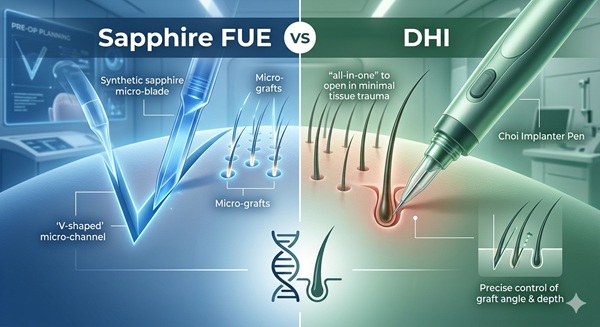
The field of hair restoration surgery has transitioned from mere hair replacement to a sophisticated discipline focused on natural aesthetics and graft survivability. Today, the choice between Sapphire Follicular Unit Extraction (FUE) and Direct Hair Implantation (DHI) represents the pinnacle of this evolution. While both methods utilize the same extraction principle—harvesting individual follicular units—their implantation phases differ significantly in terms of surgical trauma, graft handling, and suitability for specific hair types.
This article provides a clinical comparison to assist patients and practitioners in determining the most effective approach based on hair morphology and scalp physiology.
1. Technical mechanics: The procedural difference
Sapphire FUE: The precision of canal opening
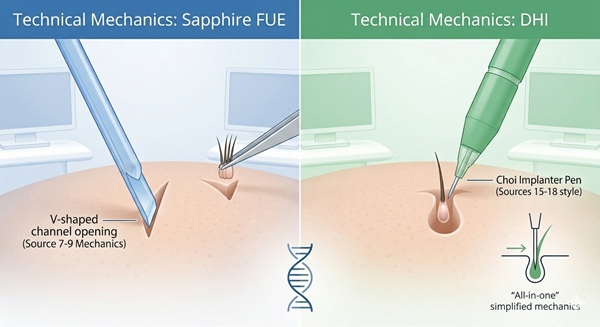
Sapphire FUE is characterized by the use of blades crafted from synthetic sapphire, a gemstone known for its durability and smoothness. Unlike traditional steel blades, sapphire allows for the creation of “V-shaped” micro-channels.
- The process: After extraction, the surgeon manually creates recipient sites (channels) before the grafts are placed.
- Clinical advantage: The sharpness of sapphire reduces tissue vibration and friction, which minimizes follicular micro-trauma and post-operative edema. The V-shaped incision allows for higher density and prevents the displacement of grafts during the healing phase.
DHI: Direct Implantation via Choi Implanter
DHI utilizes a specialized tool known as the Choi Implanter Pen. This device combines the canal-opening and implantation phases into a single motion.
- The process: The extracted follicular unit is loaded into the hollow needle of the pen. The surgeon then punctures the scalp and simultaneously deploys the graft.
- Clinical advantage: By eliminating the intermediate step of canal opening, the time the graft spends outside the body (extracorporeal time) is minimized. This significantly enhances the metabolic survival rate of the follicular units.
2. Comparative analysis: Which technique suits your hair type?
The “best” technique is rarely a matter of superior technology, but rather a matter of biological compatibility.
Case A: Thin hair and diffuse thinning
For patients experiencing thinning among existing terminal hairs (diffuse alopecia), DHI is often the preferred choice.
- Precision: The Choi Implanter provides the surgeon with 360-degree control over the depth, angle, and direction of the graft.
- Protection: DHI allows for “inter-follicular” implantation, meaning the surgeon can navigate around existing hairs without damaging their roots, a risk that is slightly higher during manual canal opening in Sapphire FUE.
Case B: High-density requirements (Extensive alopecia)
When a patient requires a large number of grafts (over 3,500–4,000 units) to cover extensive baldness (Norwood Scale 5-7), Sapphire FUE is typically recommended.
- Scalp capacity: Manual canal opening allows the surgeon to maximize the available surface area, creating a highly dense “blueprint” before implantation begins.
- Speed: In high-volume cases, Sapphire FUE is often more efficient for the surgical team, ensuring that thousands of grafts are processed in a stable, synchronized manner.
Case C: Curly or afro-textured hair
Curly hair poses a unique challenge: the follicle is often curved beneath the skin.
- Surgical nuance: Sapphire FUE is often favored here because the manual creation of channels allows the surgeon to visualize the exit angle more clearly.
- DHI limitation: Loading curly or thick follicles into a Choi Pen can sometimes cause “mechanical stress” or “bending” of the bulb if the needle gauge is not perfectly calibrated, which can lower the survival rate.
3. The Biological Edge: Graft Survivability and Tissue Trauma
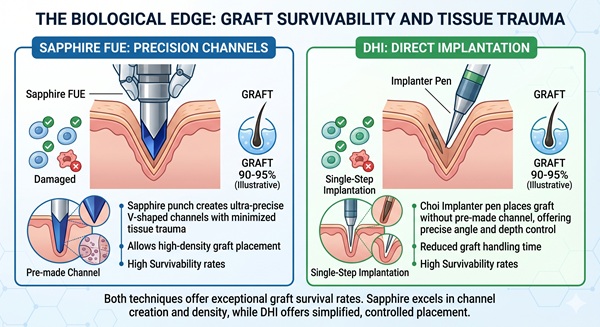
Beyond the mechanical tools, the success of a hair transplant is dictated by the ischemia time (the period the graft is deprived of blood supply).
- Tissue response to sapphire: The non-metallic nature of Sapphire blades is a critical factor for patients with sensitive scalps. Traditional steel blades can cause microscopic metal ion exchange that triggers a more aggressive immune response. Sapphire, being chemically inert, allows the body to initiate the healing cascade faster, with a significantly lower rate of post-operative folliculitis.
- The metabolic advantage of DHI: In DHI, the transition from the storage solution to the recipient site is nearly instantaneous. This “cold-chain” management is vital for the preservation of the bulge area of the follicle, where stem cells reside. By minimizing the time grafts spend in a hypoxic state, DHI can theoretically yield a slightly faster onset of the anagen (growth) phase post-transplant.
4. Physiological impact: Healing and recovery
The biological response of the scalp varies between the two techniques:
| Feature | Sapphire FUE | DHI |
| Recovery Time | Fast (7–10 days) | Very Fast (5–7 days) |
| Bleeding | Minimal (due to Sapphire’s precision) | Negligible (no pre-cut channels) |
| Post-Op Edema | Low | Very Low |
| No-Shave Option | Difficult (usually requires shaving) | High (Ideal for “Unshaven” procedures) |
5. Advanced clinical considerations: Anesthesia and PRP integration
A professional hair restoration procedure in 2026 is incomplete without discussing the comfort and biostimulation protocols that accompany Sapphire FUE and DHI.
- Pressure-based anesthesia: Both techniques now frequently utilize needle-free high-pressure anesthesia. This system uses a spring-loaded device to deliver lidocaine through the pores, reducing the “patient-doctor friction” and lowering the cortisol levels of the patient, which indirectly benefits the scalp’s vascular environment during the first hours of surgery.
- Synergy with Platelet-Rich Plasma (PRP): The integration of PRP is particularly effective in Sapphire FUE. When the micro-channels are opened with sapphire blades, the scalp is primed to absorb growth factors. Bathing the recipient area in autologous plasma before implantation creates a “bio-active bed” that stimulates angiogenesis (the formation of new blood vessels) around the newly placed follicles.
6. The role of the “unshaven” procedure
One of the most significant professional distinctions of DHI is its suitability for patients who cannot or do not wish to shave their heads (Non-Shaven FUE). Because the Choi Pen can part existing hairs to reach the scalp, it is the gold standard for female patients or professionals who require an immediate, discreet return to social life.
7. Frequently Asked Questions (The Medical Perspective)
Can DHI and Sapphire FUE be combined in a single session?
Yes. In “Combo” procedures, Sapphire FUE is often used to cover large areas of the crown or mid-scalp to maximize coverage, while DHI is used exclusively for the hairline to achieve the highest possible aesthetic precision.
Is the “Shock Loss” risk different between techniques?
Technically, shock loss (temporary shedding of existing hair) is a response to surgical trauma. While both minimize this risk, DHI’s ability to navigate around existing follicles reduces the likelihood of “mechanical” shock loss in patients with high amounts of native hair.
Which technique allows for a faster return to physical activity?
Due to the lack of pre-cut channels, DHI often shows slightly faster epidermal closure. However, for sports involving high impact or sweat, the standard clinical recommendation for both remains 2 to 4 weeks to ensure the grafts are fully anchored into the dermal papilla.
8. Clinical conclusions for the patient

While both Sapphire FUE and DHI offer success rates exceeding 95% when performed by expert teams, the decision should be guided by three factors:
- Graft count: High-volume cases (Total baldness) often benefit from the structured approach of Sapphire FUE.
- Existing hair: To fill in gaps or increase density without damaging surrounding hair, DHI is the superior tool.
- Scalp condition: Patients with sensitive skin or a tendency for bleeding may find the reduced trauma of DHI more conducive to a comfortable recovery.
Professional verdict
Ultimately, the technology is only as good as the hand that holds it. Whether utilizing the precision of a Sapphire blade or the direct control of a Choi Implanter, the most critical factor remains the surgeon’s ability to design a natural hairline and manage the donor area sustainably. At Turk Hair Index, we emphasize a bespoke approach: analyzing the hair’s caliber, curl pattern, and follicular health before selecting the instrument.
Leave a Reply