
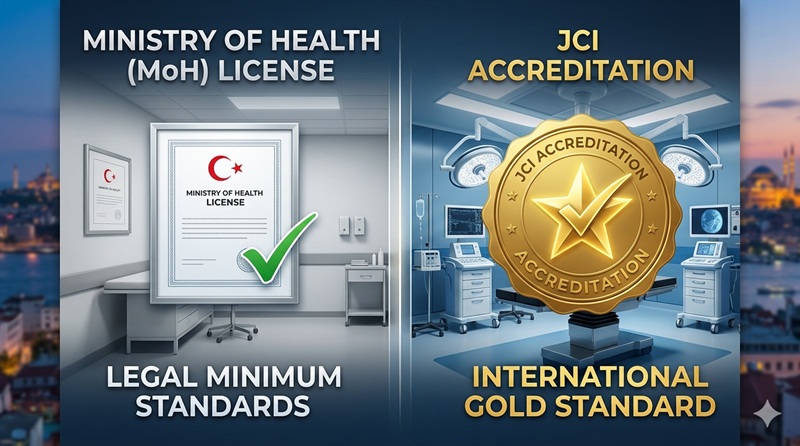
A Comparative Safety Audit: For international patients traveling to Istanbul in 2026, understanding the hierarchy of hospital certifications is the difference between a controlled medical procedure and a high-risk gamble.
The Certification Maze in Turkish Medical Tourism
In 2026, every hair transplant clinic in Turkey displays various logos on its website. Some claim “Government Approval,” while others boast international gold medals. However, to the untrained eye, these badges look identical. In reality, there is a monumental gap between a standard operating license and an international accreditation of excellence.
When undergoing surgery in a foreign country, your primary concern is not just the aesthetic result, but the emergency infrastructure. If a complication occurs, does the facility have the protocols to save your life? This is where the debate between JCI and the Ministry of Health (MoH) guidelines becomes critical.
The “Code Blue” Protocol: Why Seconds Save Lives in 2026
In the context of 2026 medical tourism, the primary differentiator of a JCI-accredited hospital is its emergency response infrastructure. A “Code Blue” is an internationally recognized emergency code indicating that a patient is in cardiopulmonary arrest or facing a life-threatening medical crisis.
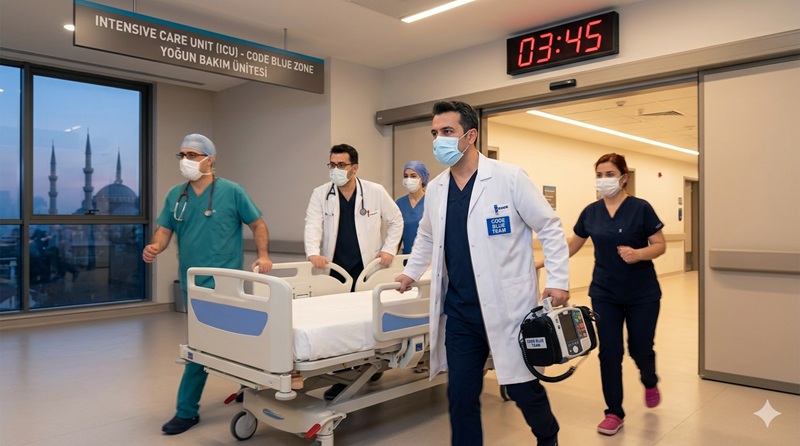
In a standard Ministry of Health licensed clinic—often referred to as “Apartment Clinics”—a cardiac event or severe allergic reaction to anesthesia usually results in a frantic call to local emergency services (112 in Turkey). Given Istanbul’s notorious traffic, the waiting time for an ambulance can exceed 15 to 20 minutes. This delay is the most significant risk factor in hair restoration surgery.
The JCI Requirement: In a JCI-accredited facility, a dedicated resuscitation team—comprising an anesthesiologist, a cardiologist, and intensive care nurses—must be able to reach any operating room in less than 4 minutes. This on-site Intensive Care Unit (ICU) infrastructure is the ultimate insurance policy for any international patient.
Ministry of Health (MoH) License: The Legal Minimum
Every medical facility in Turkey must be licensed by the Ministry of Health (T.C. Sağlık Bakanlığı). Without this, the clinic is operating illegally (“underground”). In 2026, the MoH has significantly tightened its inspections, but it is important to understand what this license actually covers:
- Legal Compliance: The facility meets Turkish building codes and fire safety.
- Basic Sterilization: The presence of an autoclave and basic sanitization areas.
- Staff Verification: Ensuring that the listed medical director holds a valid Turkish medical ID.
The Reality Check: A Ministry of Health license is a “Permit to Open.” It does not necessarily mean the clinic follows the world’s highest safety protocols; it simply means they meet the local legal requirements to exist as a business.
JCI Accreditation: The “Gold Standard” of Patient Safety
The Joint Commission International (JCI) is a US-based non-profit organization that accredits health organizations worldwide. In the world of hair transplantation, a JCI-accredited hospital is the pinnacle of safety. In 2026, only a fraction of the thousands of clinics in Istanbul operate within JCI-accredited hospitals.
Why JCI is the Ultimate Filter for 2026 Patients:
JCI standards are updated every few years to reflect the latest in global medical safety. To maintain this status, a hospital must pass an audit covering over 1,200 measurable elements, including:
- International Patient Safety Goals (IPSG): Strict protocols to prevent patient misidentification and surgical site errors.
- Infection Control (PCI): Hospital-wide air filtration systems (HEPA filters) and rigorous sterilization chains that exceed standard government requirements.
- Emergency Response: JCI hospitals must have a “Code Blue” team and a fully equipped Intensive Care Unit (ICU) on-site, capable of handling anaesthesia complications in seconds.
Laminar Flow and HEPA Filtration: Fighting Post-Operative Sepsis
While most patients focus on the aesthetic design of their hairline, the invisible threat in any hair transplant is Staphylococcus or other hospital-acquired infections. Standard clinics often use split-unit air conditioners that merely recirculate room air, including dust, skin particles, and dormant bacteria.
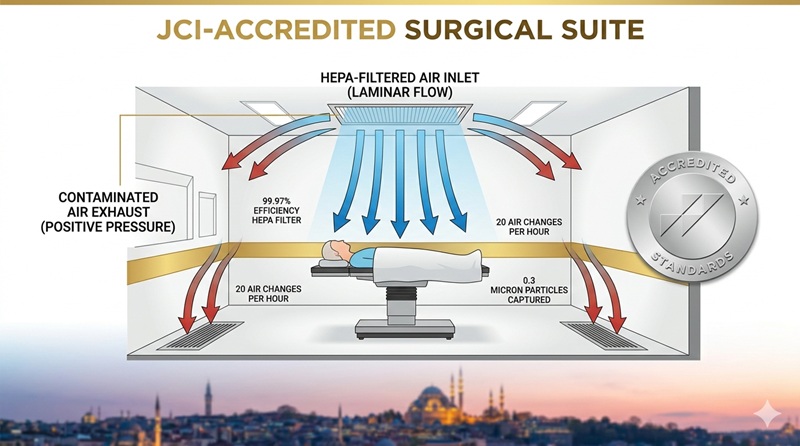
A JCI-accredited surgical suite must be equipped with Laminar Air Flow systems integrated with HEPA (High-Efficiency Particulate Air) filters. These advanced systems are mandatory in 2026 for high-standard hospitals for several reasons:
- Particle Removal: HEPA filters capture 99.97% of airborne particles, including bacteria and viral droplets.
- Air Exchange Rates: The system replaces the air in the operating room up to 20 times per hour, maintaining a sterile “bubble” over the patient.
- Positive Pressure: JCI rooms are maintained at a higher pressure than hallways, ensuring that contaminated air cannot enter the sterile zone when a door is opened.
This level of environmental control reduces the risk of post-operative infection to near zero, a standard that basic Ministry of Health licenses encourage but do not strictly enforce for minor surgical centers.
Comparison Table: MoH vs. JCI Standards
| Safety Feature | MoH (Basic License) | JCI (Gold Standard) |
|---|---|---|
| Emergency ICU on-site | Recommended, not always mandatory. | Mandatory and Audited. |
| Sterilization Protocols | Standard health code. | US-grade sterilization chain. |
| Air Quality (Operating Room) | General ventilation. | Laminar Flow / HEPA Filtration. |
| Medication Management | Manual tracking. | Rigorous digital tracking. |
The Danger of the “Apartment Clinic”
In the 2026 Istanbul market, many clinics operate in converted office buildings or residential apartments. While they may have a license to operate as a “Medical Center,” they lack the life-saving infrastructure of a full-scale JCI hospital. If a patient suffers an allergic reaction to local anesthesia (anaphylaxis), an apartment clinic must call an ambulance and wait for transport. In a JCI-accredited hospital, a resuscitation team is at your side in under 60 seconds.
This “time to intervention” is the most overlooked factor in hair transplant safety. When choosing your clinic, always ask: “Is this a standalone clinic or is it located inside a JCI-accredited general hospital?”
How to Verify JCI Accreditation in 2026
Never trust a logo on a website. In the age of digital manipulation, verification is your only shield. To check if your chosen Istanbul hospital is truly JCI-accredited, follow these steps:
- Visit the Joint Commission International Official Directory.
- Search by “Organization Type” (Hospital) and “Country” (Turkey).
- Check the Expiration Date. Accreditation is not forever; hospitals must be re-audited every three years. If their accreditation expired in 2025, they are no longer JCI-standard.
Official Link: JCI Accredited Organizations List
Medication Management (MMU): Preventing Anesthesia Toxicity
Local Anesthesia Systemic Toxicity (LAST) is a rare but severe complication that can occur during long hair transplant sessions if dosages are not managed with extreme precision. JCI standards, specifically under the Management and Use of Medications (MMU) chapter, require a rigorous digital tracking system that is absent in low-cost clinics.
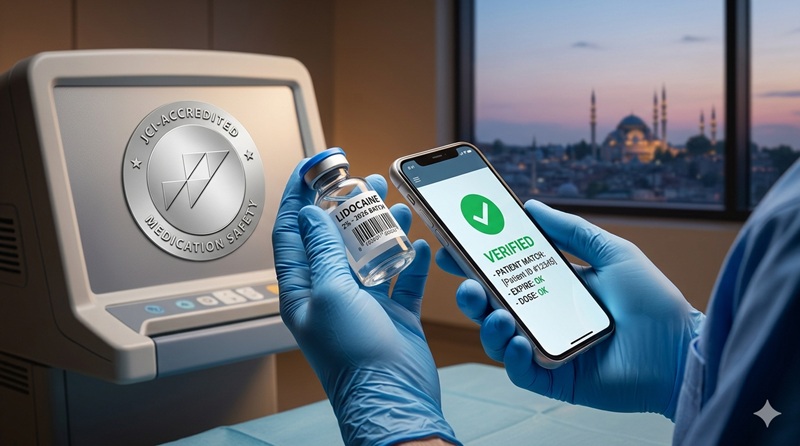
In a JCI-certified hospital in Istanbul, every vial of Lidocaine, Adrenaline, or Sedation used during your procedure follows a strict digital “Chain of Custody”:
- Barcode Scanning: Every medication is scanned into the patient’s electronic medical record (EMR) to verify it is not expired.
- Automated Cross-Checking: The hospital software automatically cross-references the dosage against the patient’s weight, age, and pre-existing medical conditions (like heart palpitations or hypertension).
- The “Double-Check” Rule: JCI protocols mandate that two medical professionals must independently verify the dosage of high-alert medications before they are administered.
Relying on manual oversight in a 10-hour surgery is a gamble. Digital traceability in a JCI hospital eliminates the margin for human error, ensuring your safety from the first injection to the last.
Frequently Asked Questions: Safety Standards
Is a JCI hospital more expensive for a hair transplant?
Generally, yes. Maintaining HEPA filters, ICU staff, and US-grade sterilization protocols increases the operational cost. However, the difference in price is effectively your “insurance premium” for surgical safety.
What is a Code Blue protocol in Turkish hospitals?
Code Blue is a medical emergency protocol that ensures a specialized resuscitation team reaches a patient in distress in under 4 minutes, a mandatory requirement for JCI accreditation.
Can a small clinic be JCI accredited?
It is extremely rare. JCI accreditation is designed for large-scale healthcare organizations. This is why the safest way to get a hair transplant in Turkey is at a clinic that rents surgical space within a JCI hospital.
Safety First: Our 2026 JCI-Audit
We have filtered over 1,000 clinics to identify only those that perform surgeries within JCI-accredited environments. Your health is not negotiable.
Leave a Reply